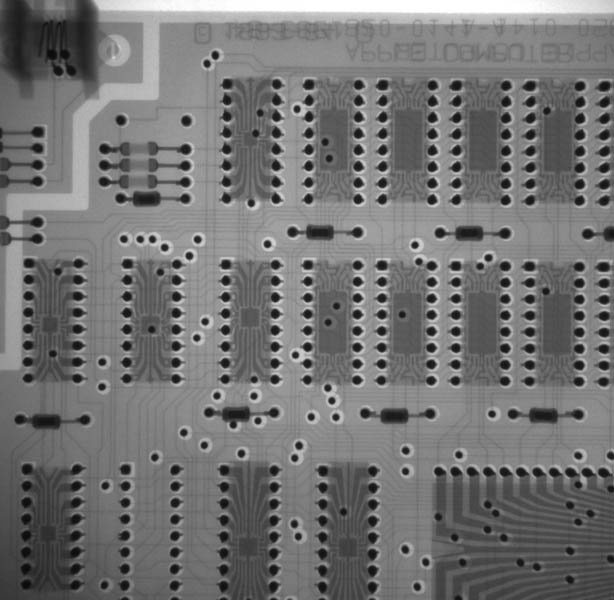
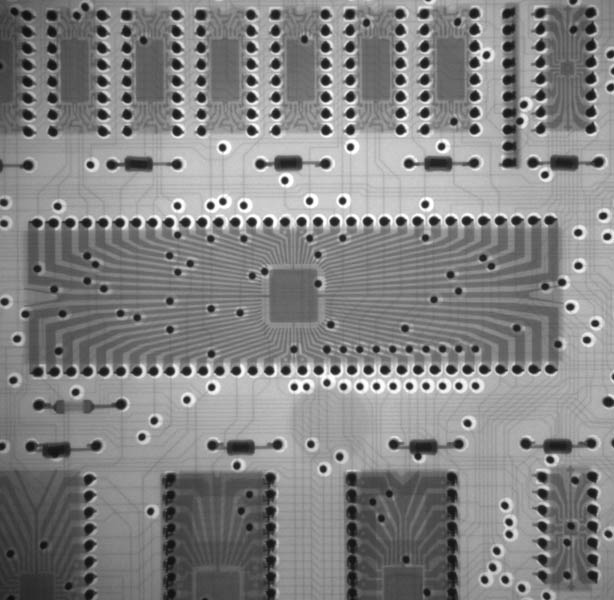
I wonder how the ROM is doing. 
Its a good thing the board only got the dose of a dental shot

Please support the defense of Ukraine.
Direct or via Unclutter App
No Ads.
No Trackers.
No Social Media.
All Content Locally Hosted.
Built on Free Software.
We have complied with zero government requests for information.
~ Est. 1999 ~
A pillar of corporate stability since the second millenium.
© 1999-2999 Tom Owad
I would guess that it's from a very early Macintosh or something from the Apple II line. The large IC, without counting pins, is either a 68000 processor or a 6502 processor. It's interesting to note how symetrically aligned the components are. That was very typical of very early boards. Newer boards aren't as tidy.
If you compare early boards to modern boards, you will notice that components used to be placed on the boards in very discernible grids. I would guess that this was either due to manufacturing restraints or to simplify the design process. More modern boards don't appear to utilize any readily apparent grid pattern for component placement.
So, which machine are they from?
It's the motherboard of either a Macintosh 128K or a 512K. As you know, both machines used the same logic board.
Its a 512k board.
The bit IC, a 68000, the ram chips on top of it (they are a bit different than other ICs), the two socketed roms underneath, and the RJ11 keyboard connector, its definately a 128/512 (the plus had SIMM slots)
And just imagine the problems that Dove Computer would have had in designing and making their clip-on RAM expansion board (MacSnap) for the 512K/512Ke if it were not so. Even so, it's quite a job to get the 2MB expansion card off one logic board for transfer to another. Is it also possible that more recent boards have had the luxury(?) of multilayer technology to get from point A to point B directly rather than via point Z?
de
Your hypothetical scenario is really all for naught; if Apple had had the benefits of modern manufacturing processes in 1984, the 512K machine would have likely been significantly more than just a "Macintosh 512K".
The Macintosh is pretty old. Most of it was made before 84, and even 83.
The Macintosh Plus is easier to duplicate than an Apple IIe.