The Data Domain

Apple | Apple I | Stories | Documents

This interview is an excerpt from Apple I Replica Creation, by Tom Owad.

Ray Borril began his career in electronics after leaving the US Army in 1956. Employed as a technician at Brookhaven National Labs, he constructed digital systems for nuclear research. Ray enlisted in the USAF in 1958 and attended courses on the computers used in the SAGE system. Honorably discharged from the Air Force in July, 1959, Ray soon founded Applied Digital Data Systems (ADDS) which became one of the leading susppliers of IBM and Teletype compatable CRT Terminals. He moved to Indiana in 1973 to work as a Systems engineer, designing and developing computer bassed systems for psychological research. In February, 1976 Ray opened The Data Domain, one of the pioneering retail computer stores. He retired in 1984.

TO: What is your background in computers?

RB: If I have any talent at all, it is the task of telling or writing “war stories” of the computer industry, which I have been directly involved with since the fall of 1958. I got into the personal computer business sort of passively in 1975, when in November I attended the famous Kansas City meeting sponsored by Byte Magazine. The purpose was to develop a specification describing the operating parameters of an interface between a serial data port on a personal computer and an audio cassette player so that data could be compatible between systems. It was a lofty but naive objective because virtually every manufacturer in the industry already had a product on the market or at least on the drawing boards. There were more than 25 people there, but I was the only one who did not represent anyone but myself. I met and became somewhat acquainted with Don Tarbell, Don Lancaster, Harry Garland of Cromemco, Hal Chamberlain of The Computer Hobbyist, Lee Felsenstein, the people from Processor Technology and IMSAI, and more. I decided there and then to open a computer store as soon as possible. It took me almost three months, but The Data Domain started in about 750 Sq. Ft. just off the Court House Square, in Bloomington, Indiana, on Feb. 12th 1976. At that time we were authorized dealers for IMSAI, Processor Technology, Cromemco, and several makers of after-market add-ons, as well as TV monitors, keyboards, every computer book we could find, every computer magazine on the market, and even computer generated works of art! At the World ALTAIR Convention in March, I met and became friends with Ted Nelson, author of Compute Lib/Dream Machine. Ted was the keynote speaker and kept the large audience in hysterics for an hour giving his somewhat risqué predictions of the future digital world. Ted was there with his friend Jim Banish, and they told me that they were opening a store in Evanston Ill. and thought we should establish some sort of relationship. They were interested in my experience and talent for selling computers and I could take advantage of their great financial management group. The result was that I became the vice president of the “itty bitty machine company” as well as the sole proprietor of The Data Domain.

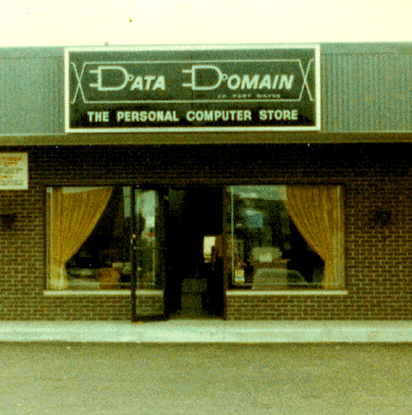
I have a picture (see figure) of The Data Domain that I took in April or May of 1976. It is my firm belief that we were the first to use the term Personal Computer commercially. DEC used it internally in 1972 or 73. and Apple used it in a Wall Street Journal ad in 1978 and got the credit for making it catch on, but I used it first!

TO: How did you become involved with the Apple I?

RB: By June the store was going great guns and I was always on the lookout for new products to sell. One day, I got a call from a young man named Steve Jobs. He had just spoken with Jim Banish of the itty bitty machine company who told Steve that I was the guy he would have to convince since I made all the purchasing decisions. He went into his spiel about what a great computer he had since there was no assembly required (a slight exaggeration since one had to wire a power supply, keyboard cable, display monitor and some other ancillary stuff, then find a way to package it all up nicely.) But Steve is a good talker and we needed more products to sell. So, as was routine in those early days, I ordered 15 Apple 1 computers with the optional cassette interface card, sight unseen, on the word of a guy I had never met or heard of, and which would be delivered C.O.D. “soon.” And thus, The Data Domain and the itty bitty machine company became two of the first four dealers for Apple Computer Co. The first dealer was The Byte Shop and the second was Stan Viet's store in New York. The Apple 1 was hard to sell because of the packaging problem, and for some reason we were never supplied with the cassette version of Apple Basic, which made some buyers very unhappy. But, eventually, all fifteen were sold, except for two. One of these was a machine we gave away to the US Olympic Tennis team. Only a few weeks later, it went down with a plane that killed several members and destroyed the Apple 1. The other one stayed in my display case for a couple of years. When it began to gain fame for its design, I decided to take it home and keep it. There it stayed for 25 years until I decided to auction it off in 2001.

TO: What was your impression of the Apple I? Did you do any programming for it?

RB: Of course, in my case, there was no real personal decision in choosing and purchasing the Apple 1 over some competitor. I listened to Steve's sales pitch and it seemed like a good idea to be able to offer a computer that did not require any soldering skill. It was inexpensive enough to sell, and we had the opportunity to increase the value of the total sale (and increase the profit margins) by selling the things needed to make a complete system, such as a cassette recorder, power supply components, keyboard, monitor, and a case, or a further option, we offered to assemble the whole thing. While my techs wrote some programs for the Apple 1, I did not and only learned to run some demos that we wrote, and things like that. I spent more of my time teaching people how to make interfaces, etc. for all of our computers. I didn't get closely involved with the Apple 1 like I did with the Apple II and S-100 bus computers.

TO: What were some common peripherals and modifications for the Apple I?

RB: Printers were popular, but in those days about the only printers available to the general public were Teletypewriters and lots of surplus units, both serial and parallel. You wouldn't believe the confusion and frustration of hooking up a simple Model 33 ASR Teletype to a serial interface when you had no idea how a Teletype works and never heard of RS-232C! One of the nice things about the Apple 1 was that it required no modifications to make it run and was a complete, working system once the ancillary stuff was assembled. Occasionally, someone would wish to change from the 6502 processor to the Motorola 6800, which the mother board was designed to allow, or add a serial RS232C interface in the “kludge” area, but these were not ordinary modifications and rarely done.

RB: The real fact is that the Apple 1 potential never was exploited by Apple. At the Atlantic City convention in August, all attending dealers were shown a demonstration of the color graphics of the future Apple II and that was the end of orders for the Apple 1.