
The A2Pico hardware comes in two flavours: SMD and TH, see https://github.com/oliverschmidt/a2pico for details.
The other day, the design files for the most recent TH variant were published, see https://github.com/rallepalaveev/a2pico/tree/main/A2Pico.v2.6
2.6 is functionally identical to the previous design. However, it puts all "user serviable parts" on the top and comes with a nice switch to turn USB power delivery on/off. And it comes with enough clearance around the USB port to allow for even bulky types of USB-A adapters (which are necessary i.e. for connecting a USB-mouse).
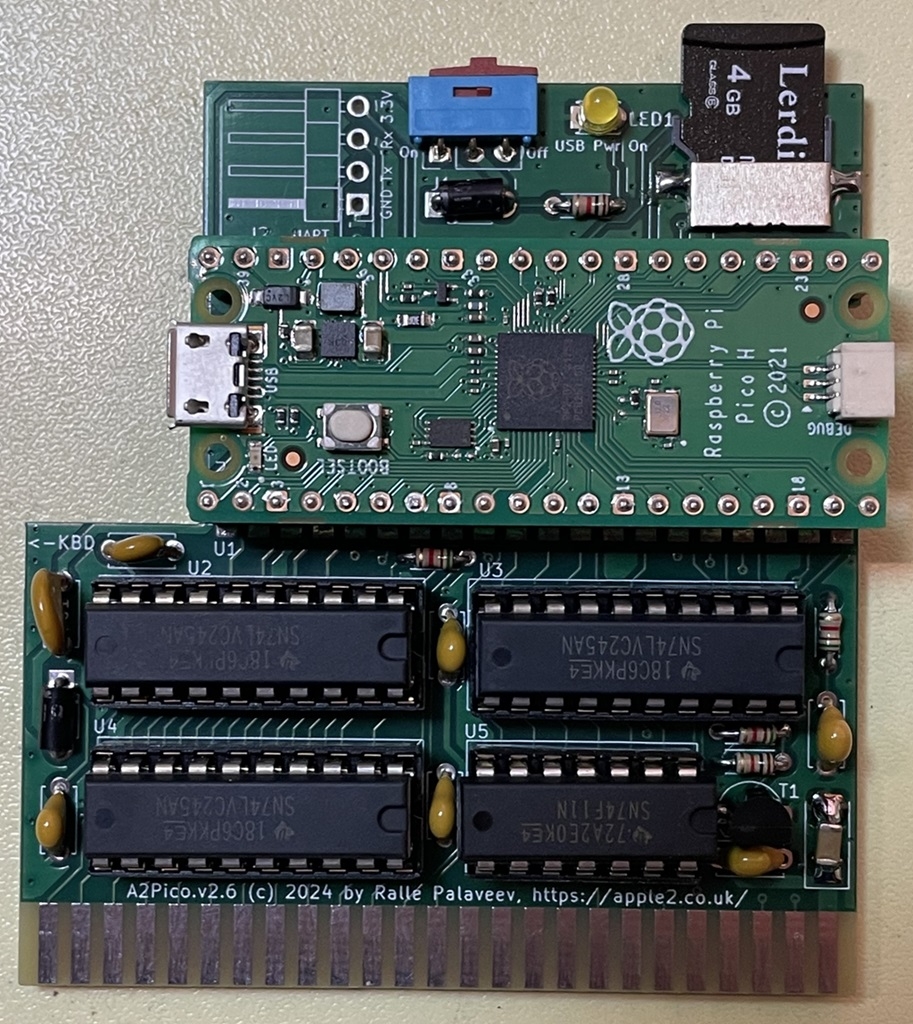
Now the SMD design files are available too, see https://github.com/rallepalaveev/a2pico/tree/main/A2Pico.v2.7
The 2.7 is an SMD design that's functionally identical to the 2.6 TH design.
I've published a new A2Pico firmware that plays the 'Bad Apple!!' video on the IIgs.
Here's the demo video: https://youtu.be/CnemTrIuyy0
Here's the project: https://github.com/oliverschmidt/bad-apple-iigs
https://hackaday.com/2024/08/27/using-the-pi-pico-as-programmable-hardware-for-the-apple-ii
A2Pico is now available in reasonable quantities at Joe's Computer Museum :-)
I just release a significantly enhanced A2retroNET firmware for A2Pico. A2retroNET implements (despite the name) a mass storage device.
https://github.com/oliverschmidt/a2retronet
Just installed. Smartport and direct hdv support on //e is really cool !
Thanks for the kind feedback :-)
Are the 8 drives all mapped to the same slot? I read through the GitHub and do not understand how 8 drives can be used.
No, at least up to ProDOS 2.4.x there are never more than 2 drives per slot. Therefore ProDOS "mirrors" aditional SmartPort drives to other slots. See https://prodos8.com/docs/technote/20/ for details.
I just published another A2retroNET update. It improves the behavior with Thumb Drives initilaizing (even) slower than the Apple II cold boots. From the updated README:
Note: Some Thumb Drives take several seconds to initialize. Therefore, a cold boot will use the SD Card. However, if no SD Card is present, the firmware waits until a Thumb Drive is plugged in and initialized.
I just released another version of https://github.com/oliverschmidt/a2retronet. This is for sure the biggest step forward so far. It shows for the first time what A2retroNET is supposed to be.
The most recent A2retroNET firmware includes an interactive configuration utility like the one you know from CFFA3000 or Xdrive. With that addition, the A2retroNET can be considered a fully feature-complete mass storage solution (in contrast to a floppy emulation).
The primary partner shop https://jcm-1.com/product/a2pico/ has reduced the price for the A2Pico to $29.99 !
I published another A2Pico firmware. It emulates a Mouse Interface card for usage with a (wireless) USB mouse. https://github.com/oliverschmidt/mouse-interface
Great !
Thanks
Hi!
Ebay search engine made me buy 74ls245s instead of 74lvc245s.
I'd like to try THO version.
Are they way too different for a reliable usage?
Thanks
I don't believe that the 74LS245 works at 3V3.
In post #19, 'ol.sc' wrote:
" I don't believe that the 74LS245 works at 3V3 ".
Uncle Bernie comments:
TTL, LSTTL and STTL (and all other bipolar logic families of the 74XXX type) are specified for 5V operation and won't work at 3.3V, at least not in spec.
If anyone has trouble sourcing 3V3 compatible logic ICs, look for 74HCxxx --- these, when powered with 3.3V, will work fine, and even be (almost) compatible with 5V TTL logic levels, although not being a perfect fit.
If you use a 5V power supply, you must use 74HCTxxx if you want logic level compatibility with TTL, although 74HC might work in some cases.
Just my 10 cents of advice ... TTL was "born" in the same year as me and as the "Ironman" comic and this means it's old, very old. Back then, TTL was called "SUHL". In the 1960s it was extremely expensive (for 10-20 such ICs you could buy a new car) and this was only affordable for the military. Then came Texas Instruments with their revolutionary plastic packaged 74xxx family wihch was so ridicolously cheap that in the early 1970s hobbyists could afford to build digital clocks from some 20-30 TTL ICs without the financial pain to put a 2nd mortgage on the house.
(I was one of this hobbyists and my 74xxx based digital clock runs until today).
- Uncle Bernie
P.S.: more and more logic families from the past will disappear / become unobtanium, so stock up as long as you can.
Ok: fair and square !
What dies SUHL stands for ?
Sylvania Ultra-Highspeed Logic? It was able to operate at 50 MHz in the mid-1960s. But I thought TTL was older.
In post #23, 'robespierre' wrote:
" Sylvania Ultra-Highspeed Logic ? "
Uncle Bernie comments:
Almost. It's called "Sylvania Universal High Level logic".
Here is a nice video with more info:
https://www.youtube.com/watch?v=Tky6yW-DTZs
... but from just watching his die pictures I could not tell if this is really SUHL /TTL --- he could have found some other Sylvania ICs. SUHL ICs are very rare nowadays. Sorry I don't have the time to trace these die shots out to see if it's TTL. But he did find the SUHL databook !
The packaging is typical for that era and it's very expensive, hermetic, ceramic with metal lids.
An anecdote: in job interviews, almost none of the recent college or University grads is able to explain how the basic TTL transistor level circuit works. When they see the collector of the input transistor going into the gate of the intermediate stage transistor, they seem to blow a fuse in their brains and their reasoning freezes. And the few which get past that question often fail to explain how the logic levels come about - it is expected that they can calculate a rough estimate based on the resistor values given and basic NPN transistor parameters. This does not look good for the future of the USA, where this technology once had been invented.
- Uncle Bernie
I have a couple of Vince Briel VGA cards, which also use three 74LVC245 chips powered by a 3.3V rail to interface with Apple II bus:
AppleIIVGA.JPG
I have experimented with various chips and I can confirm that genuine TTL 74LS245 chips from the 80s do not work. However, genuine CMOS TI 74HCT245 chips work perfectly and if the ones from eBay happen to be 74HCT series simply being labeled 74LS (fake TTLs), they might work as well.
The only caveat is that the Vince Briel VGA card only reads form the bus, so I have not tested the scenario where a 3.3V powered 74HCT245 chip writes to the bus. I expect it to work, but it would be of great benefit if someone can try the A2Pico card with 74HCT245 chips, since they are much cheaper and easier to source compared to the 74LVC245 ones.
74LVC chips are the proper ones to uise for this application because the LVC are specifically designed for level shifting. HCT chips work more or less coincidentally because they are mostly compatible with either voltage level, but they aren't purposely intended to be used for level conversion.
HCT may be cheaper and easier to source than LVC and I might be crazy but I'd rather use the "correct" chips if possible because of fears that there may be some slight flakiness in using "off-label" applications at the edge cases or in the long term.
That is true, and there is no argument about that. However, I am interested whether or not 74HCT245 chips (perhaps some particular brands) powered by a 3.3V rail work reliably in this specific use case (two-way interfacing with the Apple II bus).
In post #25, "CVT" wrote:
" I have not tested the scenario where a 3.3V powered 74HCT245 chip writes to the bus. I expect it to work ..."
Uncle Bernie comments:
CMOS can drive the output rail to rail, so for a 3.3V supply on the HCT chip the output "high level" without a strong resistive load should be at 3.3V which is fine for driving TTL. But in case of bidirectional pins, there is an issue with possible latch-up and self destruction of the 74HCT245 if it ever sees a voltage exceeding its 3.3V by more than a PN junction forward voltage (~0.6V at room temperature, ~0.4V when hot).
There also is the issue with mis-fitting input logic thresholds if 74HCT is run at 3.3V, for which HCT was not designed. The latch up issue is the same, both for 74HC and 74HCT running at 3.3V . . . only their inputs are relatively safe against higher voltages, but this depends on the robustness of the manufacturer specific input protection circuits, which normally is pretty good. Outputs of 74HC and 74HCT are not protected against overvoltages applied to them.
The mis-fitting input logic thresholds of 74HCT being run at 3.3V supply can be avoided by using 74HC, which I recommended in my post #20, but I did not know which application you really had in mind.
The reason for the 74HCT vs 74HC input logic thresholds being different is simple: CMOS logic thresholds are designed to be mid rail for a typical, centered process run. The threshold voltages of the PMOS and NMOS transistors may vary, however (the process gain as such varies less, as it's largely determined by the gate oxide thickness, and the gate oxide is the same for both the PMOS and the NMOS --- except that in case of the PMOS, it's typically a buried channel device so the "effective" gate oxide thickness for the PMOS depends on a few other process steps, too, it's not that trivial, but I want to give rules of thumb which can be understood by hobbyists).
Now, this said, what is the difference between 74HC and 74HCT ?
It's the same circuit topology but in 74HCT the NMOS transistor in the input stage is made a bit stronger than the PMOS, so the logic level threshold is somewhat decreased, to be more compatible with TTL.
And while this might work in some cases, it is just plain stupid to run 74HCT at 3.3V supply, because the whole logic threshold concept carefully designed into 74HCT falls apart in this case.
The LVT logic family is a different kind of animal, it is meant to be run at 3.3V supply, but is 5V tolerant at both inputs and outputs, and when run from 3.3V supply, is TTL logic level compatible.
This is much the same as 74HC but 74HC lacks the 5V tolerance. Which is a non issue if 74HC running at 3.3V drives TTL inputs, but for 5V logic outputs driving 74HC inputs there may be a risk, depending on how good the input protection circuits of the 74HC ICs are - in case of doubt, add a series resistor of a few kOhms. Most 74HC ICs I have investigated would not latch up if run on a 3.3V power supply and when 5V is supplied to one of their inputs. Be aware that 74HC and 74HCT outputs don't tolerate 5V in most cases where the IC is powered by 3.3V and the IC will latch up and die.
In post #27, "CVT" wrote:
" I am interested whether or not 74HCT245 chips (perhaps some particular brands) powered by a 3.3V rail work reliably in this specific use case (two-way interfacing with the Apple II bus). "
Uncle Bernie comments:
as I have explained above, 74HCT running at 3.3V would have the wrong logic level thresholds for use with TTL.
For a bidirectional bus driver, if using 74HC or 74HCT you may get destructive latch up if voltages on bidirectional pins exceed 3.3V + 0.6V = 3.9V (valid at room temperature, and typical) - most input circuits may be able to accept this as they are normally designed with an internal series resistor which limits the current followed by a diode clamp to VCC and GND, but the output transistors on the same bidirectional pin most likely will trigger a latch up if they see more than these ~3.9V. TTL driving that line on the bus typically would not source > 3.9V at a sufficient current to trigger CMOS latch up --- but all this is gambling. 74LVT is the better choice in this case.
The whole issue of running multi voltage logic families in the same system is very involved and also requires proper power rail sequencing which is different in the power up and power down ramp case. There are specialized power system management ICs which can do this but as I said it's involved. For the typical Apple II peripheral card, it's probably less headache to use 5V logic families throughout, and if some low voltage ICs shielded by these 5V ICs from the bus would be needed, add level translators after these 5V ICs, on the "inside" of your card.
It's not easy and requires a lot of care and extra components in the design, but it can be done.
- Uncle Bernie
Maybe I was not clear, but I am interested in a real test of using 74HCT245 in this particular card and the outcome (similar to my tests with the Vince Briel card), instead of an explanation of why it might or might not work. Of course I should just get a socketed card and try it myself, but I was hoping that someone had done this already.
Hi Bernie
Very interesting indeed !
Do you have a table to cross-refetence these Voltage VS 74family behaviors, showing ( matching or wrong detection or destruction or ...) results ?
Thanks
The other day I've published a new A2retroNET firmware for the A2Pico. It reads three times faster from the Micro SD card than before. That's so fast that it outperforms the CFFA3000. A2retroNET is now one of the fastest non-DMA solutions.
A2retroNET Performance
A2retroNET Config Menu on the //e
I've just published a new version of the softSP firmware for the A2Pico. Normally, the ][+ and the unenhanced //e can't autostart from SmartPort cards. However, I managed to overcome that limitation. The softSP firmware allows to autostart in all machines with an autostart ROM. There's nothing to configure and nothing special to be aware of. Just install the A2Pico in slot 7 and the Disk II controller in slot 6 like you would in an enhanced //e. Operating systems like ProDOS, GS/OS and A2osX "see" a SmartPort card as usual.
I had 5 of these in made in JLCPCB and discovered that they all have a problem: Pin 30 of the Apple II bus (the IRQ line) is shorted to the +5V rail. This can damage any card that is using pin 30, like a mouse card. I am not sure yet if this is JLCPCB's fault, or there is a problem with the gerbers. Stay tuned...
A2PicoProblem.JPG
There was indeed a misplaced stray trace on the IRQ line to +5V, which should be cut. Apologies to those affected, design files have been updated now.
Thanks for the quick reply!
On existing cards, this is the cut that needs to be made on the back side (in red).
A2PicoFix.png
My previous A2retroNET release was dedicated to performance improvments, this time I'm back to adding features:
And finally the performance tuning of my previous release caused an instability on some ][+ machines. That issue is fixed with this release - without any performance compromise.
I just updated the softSP card emulation to emulate a softSP v6a card.
I have a couple of questions on the IRQ / +5 V bug from above:
Thank you very much.
With the +5V-IRQ line short bug, any card that tries to utilize the IRQ line can be damaged, since it will try to pull to ground the +5V rail. The only card that I know that utilizes the IRQ line is the Apple Mouse Interface and only when running a program that uses the IRQ, like MousePaint. Mouse programs that do polling (like A2Desktop) will not cause damage, since they do not use the IRQ line. Luckily I never had the shorted A2Pico card and my original Apple Mouse Interface card in the same machine at the same time.
In theory this bug can also damage the Pico on the card when the A2Pico card itself is configured as a mouse card and you run MousePaint. However, in practice the Pico was fine after running MousePaint on the shorted card numerous times while trying to figure out what is happening. The Pico was not damaged and simply MousePaint did not work. Even the transistor T1 on the card itself did not get damaged, but it got so hot it almost burned my finder when I touched it. There was no damage on the Apple II PSU either. After making the cut, MousePaint was working fine without changing the Pico or T1.
https://github.com/oliverschmidt/super-serial-card/blob/main/README.md says [...] Interrupts are not supported [...]
A real Super Serial Card II however can be damaged if used in the same machine with a shorted A2Pico card, since it will also try to pull pin 30 (the IRQ line) to ground:
SSCBack.png
Yes, I noticed that as well and I was concerned when I looked at the schematics that this is the case. I had a real Super Serial Card in one of the slots while I was trying out the A2Pico card. From the schematics I learned that this line is routed via switch 6 of switch pack 2 on the card. In my case the switch was set to "open", lucky me. This means that there was not electrical connection to the IC which controls the line, so no harm done. However, my understanding is that, even if the switch is set to "closed", it does not necessarily mean that the card will be damaged. Only if the card tries to pull this line to ground you have a short. Unfortunately I have no clue when the card does this. Maybe someone else has further information on this topic ? Thank you.
The /IRQ signal is an interrupt request: it notifies the CPU that the peripheral requires attention. Serial communication UARTs have an internal data buffer that holds the recent characters received, or the next characters to send. The CPU needs to service the UART before the buffer is used up (or there will be an overrun/underrun error).
You will find that information in the SY6551 (ACIA) datasheet. It has a single character buffer, so the /IRQ is asserted every character (e.g. at 2400 bps, it signals /IRQ every 4 milliseconds). If the /IRQ line is disabled by opening SW2-6, the program must loop every 4 milliseconds to check the serial card. This type of manual service loop is hard to make work at high speeds.
Would that be an issue with other serial cards, or just with the Super Serial card?
The best way to tell is simply to look at pin 30 and see if it's connected to something on the card. This is the fifth pin on the back, as shown in post #42 above.
The A2Pico2Lite lacks an SD card slot, but A2retroNET works with USB thumb drives as well. That is why I have - finally - released a version of A2retroNET for the A2Pico2Lite. However, please keep in mind that A2retroNET still operates significantly faster when using an SD card. USB thumb drives are fully hot-swappable. If no USB thumb drive is plugged in during boot-up, A2retroNET now displays a spinner.
This spinner is now also displayed on the A2Pico if neither an SD card nor a USB thumb drive is present. Additionally, the A2retroNET variant that supports a connection to a PC instead of a USB thumb drive now prevents the endless stream of Windows error messages that would otherwise occur if no SD card were inserted.