
Good afternoon!
First, a little boasting ))) My construction of the Apple][ system is moving a little bit! At the moment I have a working configuration from the Rev.0 motherboard, BrainBoard ][, Saturn 128card, Apple][-VGA and DAN][ controller. To this kit I assembled the Unified Retrocomputer Keyboard, which works great with the encoder on the Atmega328p. I designed all this in an acrylic case with a TFX power supply, in which I provided opportunities for any expansion. Now I have also made a laser engraving of the “real” Apple][ layout on the keycaps (it is not in the photo yet) and also made an acrylic case for the keyboard - it looks great! Also everything works fine when I use TJBoldt ProDOS ROM Drive instead of DAN][ controller. Thanks to Alex Kwiecinski for a nice compilation of old software !
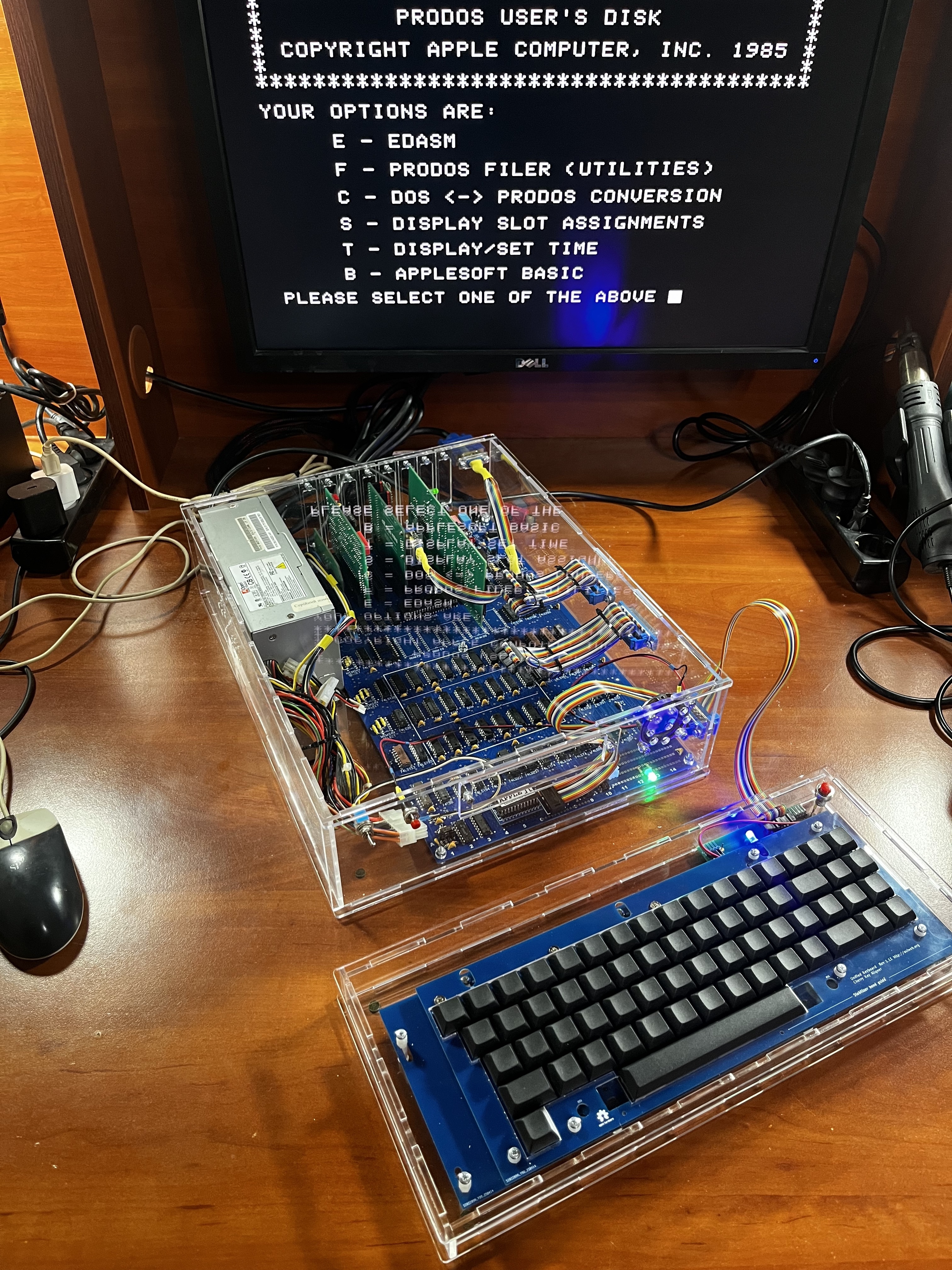
But there are also difficulties. The fact is that I have never dealt with Apple equipment before, my hobbies were only MSX and 8086/8088 systems. So do not be surprised if my questions seem funny to you.
I assembled a 16k Language Card by BTB, but it stubbornly refuses to work. Regardless of the position of the switch on it - my system does not see 64K of memory. All the chips on the Language Card, including SRAM - 100% good, checked twice.
I still will not study the features of the formation of Apple][ ROM . Do I understand correctly that the ROM installed on the Language Card should replace the ROM F8, and at the same time the ROM F8 from the motherboard should be removed?
But the fact is that instead of ROM D0-F8 I use BrainBoard ][. And I understood that in this case no ROM should be inserted into the Language Card ? Maybe some special configuration of switches on BrainBoard ][ and on Language Card by BTB is needed? Maybe some special firmware is needed for ROM installed on Language Card by BTB?
Sorry for my imperfect English..
lc.jpg
If you have a Saturn 128 card, that does everything the language card does, and more - you don't need both.
The basic Apple II has 48K of RAM, 4KB of I/O space, and 12K of ROM. A language card (or Saturn 128) allows software to temporarily disable the ROM and bank-switch RAM in its place, giving you a bit more memory to work with - although only a maximum of 60KB is available at any one time (the I/O space can't be switched out, since that's where the switches live).
Good afternoon! Thanks for the feedback! Yes, of course, I don't need both cards at the same time. Saturn128 in itself completely satisfies me.
But I fundamentally want to understand why I can't get the Language Card to work.With switching 16KB (in fact, 12KB) of memory between ROM and RAM - I understand.
But what function does the ROM installed on the Language Card have?Is it mandatory to install it if I use BrainBoard ][ ? - If mandatory, then with what firmware?Because I have the impression (possibly wrong) that this ROM duplicates the F8 ROM of the motherboard.
Because when I remove BrainBoard ][ , and insert the Apple Monitor ROM into the Language Card - the system starts up and works in Monitor mode...
The original Apple II ROMs contained Woz's Integer Basic programming language. Later the Apple II+ came out with Applesoft Basic (based on Microsoft Basic), and the "Autostart" feature that would automatically boot the first available disk-drive at power-on. Unfortunately, to make room for these extra features, some things had to be removed, like the "mini assembler" in the assembly-code debugger. Of course, there was also third-party software that tried to call into the Integer Basic ROMs, that wouldn't work correctly with the Applesoft ROMs.
Luckily, the Apple II slot pinout includes the CPU address bus, data bus, and a signal to disable the ROMs on the motherboard, so Apple made the first "Language Card": a card with the Integer Basic ROMs on it, and a big switch that stuck out the back of the machine: in one position, the switch disabled the ROMs on the motherboard, making the ROMs on the card active; in the other position, the card did absolutely nothing, and the computer ran as normal. So if you wanted to switch from Applesoft to Integer Basic or vice-versa, you'd turn the machine off, flip the switch on the language card, and turn the machine on again.
As time went on, not many people needed to switch between Integer and Applesoft BASIC, but more people wanted access to more RAM, so Apple made the second "Language Card": a card with RAM on it, and a software switch that controlled whether the RAM replaced the motherboard ROMs. You could still load Integer Basic into it if you wanted and use it like the original Language Card, but you could also use it for anything else you might want an extra 16KB of RAM for.
It looks like your Language Card is trying to be the best-of-both-words - it has RAM *and* a ROM socket with a switch. I'm not sure how they interact - does toggling the switch to enable the ROM on the language card disable the RAM on the language card?
Also, I'd be careful of conflicts between cards: it looks like the language card and the Saturn 128 are both trying to replace the motherboard ROMs with RAM, while the language card and the Brain Board ][ are both trying to replace the motherboard ROMs with other, different ROMs. There's a lot of scope for things to get confused and interfere with each other.
I can confirm that as well. I had these two cards interfere exactly in this fashion:
IMG_5959.JPG
It is exactly because of these conflicts that some of the newer 16K and 128K RAM cards (such as the RAMX128K) have implemented a "ROM Sharing Protocol" to address this. It builds upon the design first introduced with the Apple II Firmware (ROM) Card but unfortunately abandoned with the later Language Card and subsequent 16K RAM card derivitives.
See https://www.applefritter.com/content/ramx-128k-board-now-available for more info.
Any Saturn RAM card and an exact clone would interefere with the red bullshit card on the left, if CVT's obvservation is true.
The fault is not with your Saturn Rocket 128K card. The MultiROM card was also interfering with my Pravetz 128K RAM card:
Pravetz 82 128k card.jpg
which is a clone of the Legend 128 KDE Soft Disk:
Legend Soft Disk 128k.jpg
The red card appears to be a modified knock-off of David Mutimer's MultiROM design which is in turn a modernized clone of an old vintage card using GAL and modern higher density EPROM/EEPROM.
The MultiROM Rev 1.1 does support ROM Sharing so it can co-exist with RAM cards that also support this.
Good to know. I've got several machines and multiple options for things like this so for me it usually isn't an issue, but I imagine for others that functionality could be important.
Yes, I am also inclined to think that there is a conflict between my Language Board by BTB and BrainBoard ][ .
But maybe someone has had experience overcoming this conflict ?
Apparently, the GW4208B board design foresees and eliminates this conflict.
bb.jpg
128k.jpg
Then maybe I should try using the ROM Replacement Board instead of the BrainBoard ][ ? .
Maybe it will be able to coexist with the Language Card by BTB ? (see photo)
lc.jpg
rPl.jpg
The simpler you can keep things, the more likely it will be to work. Using the ROM replacement with the language card should work. You may need to change the position of the switch on that language card if you have an EPROM installed on it. You probably really don't need Integer BASIC for anything most of the time so you may also need to adjust the jumper on that ROM replacement card.
Yes, that should work. Just don't put an F8 ROM on the BTB Board.
)))Yesterday my friend wrote to me - he faced the same problem!
BTB Language Card refuses to coexist with BrainBoard )))
Thanks to previous contributors for the advice. I have already ordered ROM replacement boards from PCBWay - I am waiting for delivery.When they arrive - I will definitely write back about the results of the experiments.
By the way, there is one more question. What do you think - is it possible to use a ROM chip from Brainboard in a ROM replacement board?
Or create a new one, and in what order to create it? D0+D8+E0+E8+F0+F8 or F8+F0+E8+E0+D8+D0 ?