
Hello Apple Fritterites . First time poster here on the forums. I'm a software dev by trade, but love to tinker in basic electronics. I have 2 clone PSU's that are non-functional. I hope to get one (or both) working again, as there's is a ][+ clone PCB that I started to assemble 40+ years ago, that I want to finally complete. There is zero technical information available ("CHAR-PHON" manufacturing label, and that's it). These are based on the TL494 PWM controllers to create a switching power supply. (there is NO RIFA caps in these units :) ). The original power transistors were 2SC2827's .. but I found one of them was blown... so I replaced the pair with TIP41C's. (I could them more easily than trying to source the original devices). First attempts to simply "identify failed diodes/rectifiers/capacitors", and swap them out, resulted in catastrophic failure, including vaporizing traces on the PCB. The interesting part here, being that this failure occured when power was applied to the PSU.. which was still turned off. Further investigation revealed that the neutral line was connected through the switch, not the HOT/LIVE line. So I think that this could account for energizing the unit even though the switch was turned off. Further internet sleuthing found a schematic for a generic TL494 driven switching supply, authored by someone called 'toothache'. This schematic was very similar to the input side of the circuit (which I've been slowing tracing out over the last week). I have updated it based on the tracks of the PCB and wiring of the existing supplies. One thing I discovered, however, is that at some point one of the two large caps just after the bridge rectifier, was reversed. (C5 in the diagram (hopefully attached)). The question I have is.. would that reversed capacitor explain the 'short' that occurred and the flash bang vaporization of the +V (DC) trace on the output from that 4-diode bridge?
Attempt to resurrect clone Apple II supply
March 12, 2026 - 2:01pm
#1
Attempt to resurrect clone Apple II supply
Here's my work in progress tracing out of the PCB/components. It is the dark blue (DC V+) that overloaded and about a thumbs width of copper trace vanished in a flash /puff.
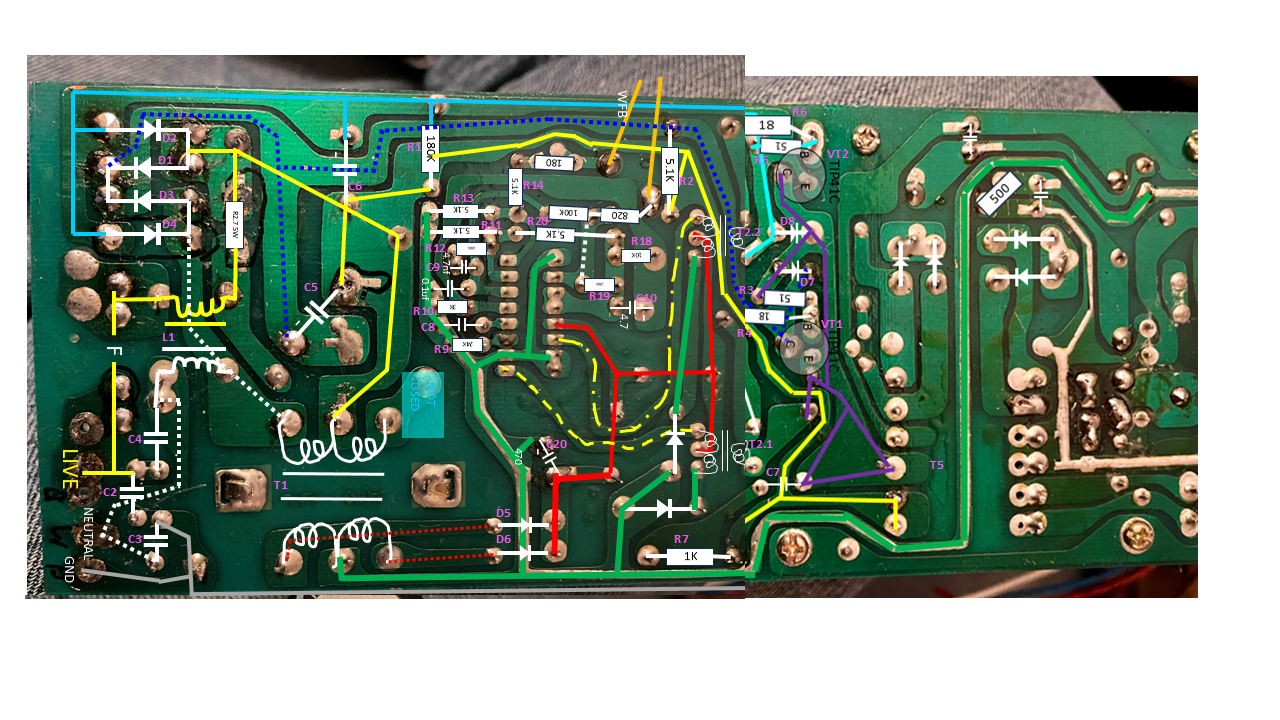
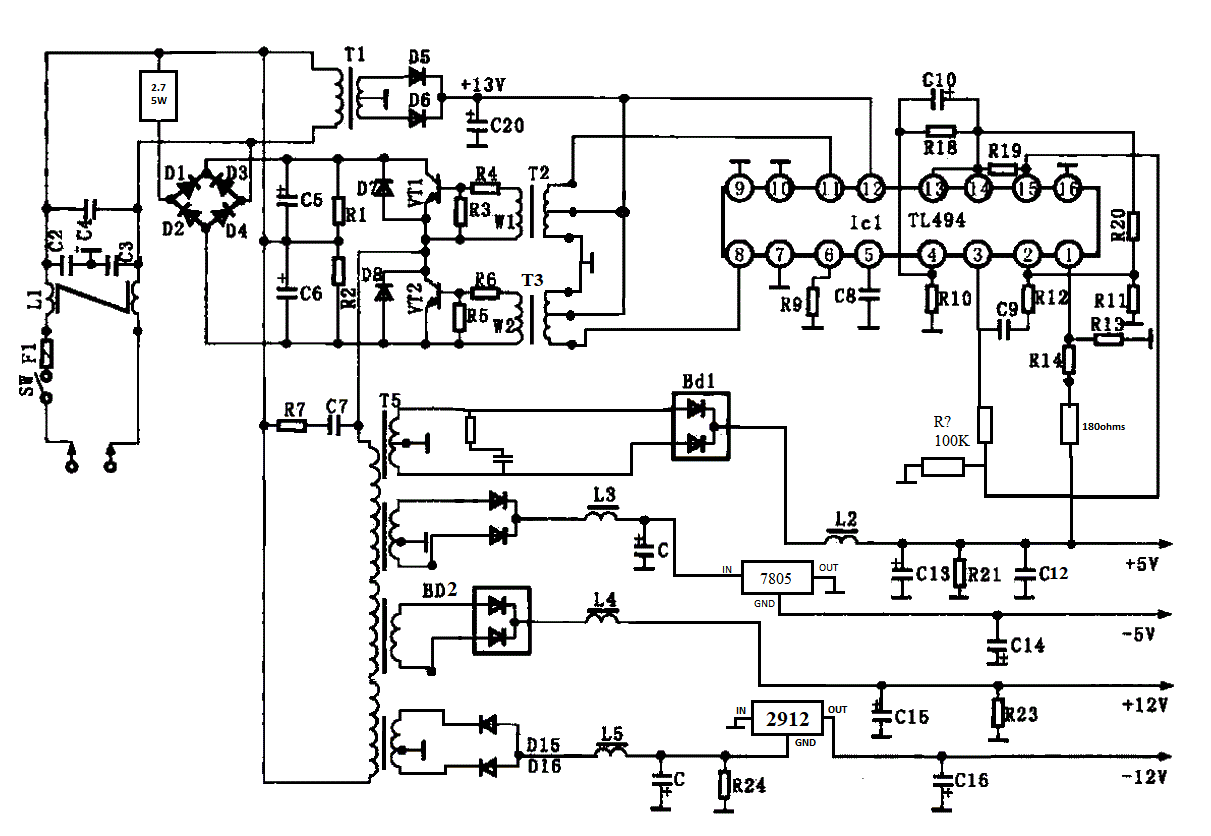
(I hope that made sense)Here's the updated schematic that I *think* .. now matches the supplies in hand. If you're still reading.. THANK YOU!! I look forward to learning more about how these work, and ultimately getting to the APPLE boot screen once more.
Switching the neutral side should work just as well as switching the live side; in fact, most PSUs are totally polarity agnostic with their input circuit.
Are your replacement transistors functionally identical to the originals? RDS_ON etc?
In any case, there would appear to be a serious problem with the design or components if you have traces vaporizing. Normally a fast acting fuse would prevent cascading failure of that type. It's even questionable if such a design would meet UL standards.
It's harder to follow the photo, so just going by the schematic, the "2.7 5W" component is a NTC thermistor for soft power on. The midpoint of the two primary reservoir caps is connected to the AC line because this is a voltage-doubler circuit for 120V input up to around 300 VDC.
The problem causing the short circuit is on the primary side, but I noticed that on the secondary side, the linear regulators look wrong. Negative voltage supplies use "79xx" devices. –5 V should be a 7905 and –12 V should be a 7912. The In-Out-Gnd terminals of those regulators are all mixed up.
With respect to electrolytic caps, they can violently explode if reverse voltage is applied. The dielectric is only good for blocking voltage in the direction indicated on the sleeve. In reverse, they break down and allow DC to flow through, which makes sense when you know that aluminum electrolytic cells were originally used as rectifiers.
Thank you for the reply. I was very surprised by the spark, as the switch was actually open at the time (as such the 2.5A fast acting fuse wasn't involved at the time of the sparking event). In fact .. the fuse remains functional after the flash/bang. One of the rectifier diodes blew at that time as well.
If I understand correctly, the live (which was connected on the non-switch side) must have been shorting to the COMMON/GND ... as the neutral was never engaged due to the switch being off.
On the output side.. I realize the 7805 setup looks off, but after some additional google-fu.. I have read that generating -5v *is* possible, if the output is connected to the GND. So while my initial reaction was "I must have traced this wrong".. I think it may actually be correct. Quoting Google AI: "This only works if your load is floating (not connected to the original power supply's ground)."
When I read your assertion that the 2.7ohm 5W resistor might have been a thermistor, I went to double check. Of the 2 PSU.. only one of them has it populated, as a ceramic cement 5W 2.7ohm resistor. I vaguely recall removing the one as it was physically broken ... but this was 40 years ago that I did that. So I ask that you excuse my recall a bit. What's there now is not a thermistor ... but the question now is.. SHOULD it be a thermistor? I have a pair of 7 ohm PTC thermistors here (intended to wire up a degausing coil on a small CRT). As my understanding of thermistors go.. I would *think* that would be a reasonable subsitute .. but certainly not my area of expertise.. so I'm open to receiving additional guidance / education. :)
For soft-start (reduction of inrush current when power is applied) the thermistor must be NTC. That makes the input look like a higher impedance to the AC line, so less current flows into the primary capacitors. This is done to lower the stress on the components like caps and diodes. The NTC heats up quickly and drops its value so less power is lost.
You should see the ASTEC 11040 and 11040B schematics, where it is designated R1, 4 Ω or 5 Ω at 25° C.
Also check your fuse is correctly rated and not a fake. The 11040 uses 2.75 A.
Learned sumthin new today... "thermistors" have two flavours .. PTC and NTC.... thanks for that.
The fuse (which is in series with the power switch) is/was never engaged before the sparks flew. So I don't think they (two different types now) are the source of the fault. You had mentioned that an electrolytic cap that was installed in reverse, could break down and allow current to flow. The trace that turned into a fuse, was the DC V+ coming off of the bridge rectifier. (this would be the "voltage doubled" DC +) *and* it would have been on the receiving end of the inverted capacitor. Still don't quite see how this could have shorted with the neutral disconnected (unless the power switch itself is faulty.. something else for me to check in the morning). Will look into ordering some *N*tc thermistors ... and building a dim bulb tester that I can run in series with the power supply.Thx for the constructive feedback.
Labrat, would you show a full pictures of the component side of the PSU and of the solder side wihtout any editing. If you've double checked the orientation of the rectifier diodes prior the presently installed 7805 then it can't be a linear 7805 . Most likely someone with their non-qualified repairing attempt had replaced it with a linear 7805 while the original part was similar or equivalent to this one:
https://www.belfuse.com/media/datasheets/products/power-supplies/P7805-S.pdf
The majority of the A2 (including clones) vintage PSUs have a red warning sticker on top of their case, read it once again.
Red label noted: caveats being .. I know enough to not poke inside when connected to mains (screwed closed before attempting to energize). Also careful discharge of caps before pulling them for testing. I'm trying to solve the puzzle based on the schematic and learning futher as to what *could* have gone wrong. Building the schematic from tracing the board and comparing to a reference design.
IMG_7530_ORIG.jpeg
IMG_7531_ORIG.jpeg
IMG_7532_ORIG.jpeg
IMG_7533.jpeg
IMG_7534.jpeg
IMG_7536.jpeg
Given that the switch was in the OFF position, and still there was an inrush of current. I would think that this indicates it must be flowing from LIVE to GND. I realize that the AC GND isn't called out in the schematic. (It's there as a GND symbol for caps C2/C3) .. *AND* C12 on the 5v output. That's it for the AC/GND connections.
Just a quick follow-up on the investigation on the missing thermistor. Further sleuthing reveals that some very early vintage power supplies used a low resistance (eg 2.7 ohm) 5W resistor to limit the inrush current. The design was later updated with the 4 to 5 ohms NTC thermistors. So what's there "ain't wrong" .. but could be better. :)I've ordered some 5D thermistors to fix things up.
Review of the schematic against the PCB and found that the reference design, while having the same components, was slightly differently laid out. Specifically where those initial capacitors tie in (BEFORE the fuse). So here's the updated schematic... (mea culpa for not paying enough attention the first time).
AppleIIClonePSU_ModifiedSchematic.gif
The switch might be miswired, or fused together internally so it is unable to disconnect, or the RFI capacitor (C2) from neutral to earth may be shorted in that case. With fuses, some people replace them with too high a current rating to paper over other problems, which is dangerous and needs to be checked for.
The 7805 or uPC2912 are positive regulators and will not work with negative voltages. Always check for prior incompetent repairs.
(The P7805 mentioned by transwarp2 is a DC-DC switching converter and not a linear regulator like 7805)
I had replaced the fuse (previously 3A) with 2.5A (which is .25 lower than rated I believe), however the fuse didn't blow before the trace vaporized. Took the continuity tester to the switch, and it is behaving as expected. Pulled the three Ceramic Disc CAPS (again) C2,C3,C4... all tested (using 'cheap device tester') within a "reasonabl ish" tolerance of expected values (eg. 2026, or 2600 for a 2200pf cap). I think this puts them all in the "not great, but likely okay" category, and clearly NOT shorted.
With the caps out, I tested for continuity between the COMMON (AC GND) and HOT, and NEUTRAL inputs. Not a dead short, but there was continuity there (which shouldn't have been). I removed C12 which bridges the AC/COMMON to the GND output, and *STill* had some continuity. Eventually removed the screws for the heat sinks (the only other thing that was in contact with the AC GND trace. This leads to the discovery that one of the (replaced) power transistors is somehow making contact with the heat sink (despite the rubber insulation layer that was in place). Pulled that appart and on micro-inspection find a couple of pin-holes in the rubber sheet. Did some re-arranging as I reassembled, and with the heat sink in place, there is no longer a continuity detected between COMMON and HOT & NEUTRAL. (phew) . Just need to replace C12, C2,C3,C4 and re-re-re-check if there is any apparent leakage/path from the GND to the HOT/NEUTRAL lines.
I have just realized that the DIM BULB tester I was creating this morning, probably wouldn't have help in this scenario, unless I put a second bulb in series with the COMMON/GND connection. As the darned thing wasn't zapping through the standard HOT-->NEUTRAL connection. (hope that parses)
As to the use of the 7805 to generate -5V. Google-Fu says while this is not ideal, that is *is* possible.
Specifically referencing: ST: L78 - Positive voltage regulator ICs (page 26 ish) there is a diagram for generation of -Vo. I *do* understand that this isn't standard today, but this does appear to me to be what the original designers of this supply had in mind. Not something a modern supply would do.
LabRat, what is your educational background?
Formal: Software developer (40+ years) working at the lowest layer (firmware/drivers/OS). Informal: 40+ years of tinkering with electronics, and firmware development. I do some PCB designs, mostly through modifications to existing reference designs. Handy with a soldering iron (started with this apple II clone that I never completed), all the way up to hot air rework .. haven't tried a BGA yet.
Based on discovery of the short between the collector of the power transistor (VT1 in the diagram) and the heat sink (which was grounded).. I think this now explains the current flow from the AC (non switched side), through 1/2 of the bridge (D3 in the diagram) .. into the trace .. through the short to GND. (FLASH/BANG copper trace of the DC V+ line becomes a fuse) (also frying D3 at the same time).
I have to take ownership for that short .. as I recently did the replacement of the VT1 (replaced with a TIP41C). Perhaps I over-tightened the clamp holding the transistor to the heatsink. The issue of the reversed CAP C5 .. might have been me in the past.. or could have been a previous repair attempt. As I had no schematic I wouldn't have had any way to know it was wrong. With my efforts to recreate the schematic, it became apparent that C5 was installed in reverse.
As to the 7805 for generating -5v. I'm reporting as to what was here on the PCB.. and reproducing that in the schematic. It looks squirrelly by todays standards. No argument from me there. But by the standards of when this supply was designed.. (and this is where I hit google to try and find examples from the past).. it seems that this squirrelly design may not be without some merit (for the time). I have two of these supplies, one that I have been acitvely working on, and the other I was keeping as a reference (and donor parts). I will pull that second heat sink (which has the two regulators and BR1 attached).. to see if they are the same 7805/2912 regulators). EDIT: Confirming that the second supply is the same, with a 7805 and 2912 in the configuration detailed.
What you are telling is not an educational but rather working background.
I assume the rectifier diodes and the electrolytic capacitor around L3 in your derived schematic are orientied properly. They tell us that there is positive voltage / inrush current into the input of that P7805 component. Threat the component 7805 as a 3-pole unknown black box, you know its input and output though. Apply these Laws too, and maybe many of us will understand that a linear 7805 AND 7905 cannot be used there:
https://en.wikipedia.org/wiki/Kirchhoff%27s_circuit_laws
Either the diodes and capacitor must be in the opposite direction, or a DC-DC converter that electrically isolates via its internal transformer both circuits must be used in place of 7805, like the one in the datasheet I provided for example.
Correct.. it's not formal training (barely informal really). I suppose on the formal side was the "intro to circuits" portion of 1st year Physics... but that was so long ago I don't think it would count. So I'm certainly open to being educated.
The ST document I linked shows:
7805_NegativeSupply.png
Which I *thought* aligned with the circuit I've been drafting from the boards here. Differences being the 1/2 bridge (is that the correct term?) versus a full bridge, and I *think* it's a center tap on the secondary side (based solely on the number of pins on this unlabelled transformer. (Appears to be 4 secondary's.. 3 with center taps, and one without (the fly wires that connect to BD2).
I hope I'm not coming across as argumentative. I appreciate that you are taking the time to look at this, and to share your experience with me. It is certainly possible that I have incorrectly traced portions of the circuit. (Case in point I really don't know if the DC going into the T1/T2 transformers, would be going in on the center tap, or on the outside (where I have the GND). I've posted it this way solely based on the pin position on the PCB.
Slide3.png
The ST document is correct. For now, until you understand the -5V problem , you can disconnect the 7805 input as shown in your schematics, or completely desolder it. You can live wihtout the -5V rail until you fix the rest of the PSU. There is a chance it will start operating because presently the 7805 , according to your schematic, is shorting the -5V side, or at least draws to the limit of its triggered protection of 1A or so.
Figure 17 (which I had seen yesterday by following your link) is just a funny way to draw the generic positive regulator circuit (and I believe it contains a mistake, which is exchanging pins 2 and 3). The voltage on the regulator is still positive, but if the input port is actually isolated, then you can assign any "level" you want to the outputs, as long as the Out pin is higher than the Gnd pin. The outputs could be called "2.5 V" and "–2.5 V" and it's all the same from the regulator's perspective. This is because the outputs of the diode bridge are not referenced to ground, but are "floating" so-called. Once the input port (including the In and Gnd pins) is referenced to ground, the choice can no longer be made how to assign meaning to the output voltage because it is already defined.
Have you noticed that the red and black probes of a multimeter can easily be reversed, but doing so changes the sign of the readout? The choice of which point to make the ground reference (the black probe) exists so long as no ground is already connected. That's all that is going on in Figure 17.
L7805 %22negative%22.png
When connected in this way, the direction of current in the positive regulator is still the same. Current is into the In pin, and is sourced out of the Out and Gnd pins as it must be in a positive linear regulator. A 7805 can't sink current into its Out or Gnd pins (which is why they do not tolerate backfeeding if the Out is higher voltage than the In pin).
While driving back I had a "oh wait" moment, and I realized that I hadn't properly captured the "-5V" line and it's relationship to the transformer. Here's Yet Another updated schematic ("now with version numbers!!"). Teal line from the trace image, connects (I think) to the center tap, which I had erroneously captured as GND.
I'm highlighting the change in BLUE in this version. Does this now make more sense?
AppleIIClonePSU_ModifiedSchematic_v3.gif
The replacement thermistors arrived, and have been installed. I've pulled, tested, and reinstalled all the electrolytics on the second supply. (with only one being widely out of spec (replaced)). As with the first supply, one of the power transisters was shorted, so it has been replaced. The two voltage regulators showed no signs of shorts, so were re-installed along with the diode bridge. Pulled each of the diodes in the bridge with no shorts detected. Continuity tests reveal nothing untowards.. so may be ready for next stage of testing. Before energizing (or tying to).. I will screw them all back into their cases, as well as fabricating a reasonable "test load" (12v automotive bulbs seems recommended).
Stabilization aside, for a negative voltage two-diode full wave rectifier, you need the diodes reversed compared to a positive voltage one: click!
In his latest corrected schematics (with blue GND line) the two rectifier diodes are in the right direction.
That is true, with the latest correction the rectifier essentially looks like this: click!
No need to click on external links. This was studied well in family, later on in technical high school, and later on in technical university under good old soclialist education in our country that was ruined after the "Wind of change", along with the semiconductor and the rest of the industry and agriuculture.
So it seems the schematic capture is approaching an accurate representation of the pcb.. however something still amiss.
Fuse_Snafu.jpg
Err #2 .. Dim light tester .. went bright and then dimmed (a bit).... I interpreted this as ok to continue. That was mistake #2 .
Err #3 .. Add #1 & #2 ... and the wires for COMMON&HOT .. turned into fuses at the point of contact with the PCB. So clearly *still* something amiss here. At least one diode in the bridge now shorted.. and will have to be replaced again. No surprise.. the fuse did NOT blow (see ERR#2).
I will stick to studying the schematic, as I re-attempt to get 2.5 (or 2.75) Amp fuses. May have to pony up the $20 for Mouser shipping.
The post mortem results D1 shorted, R3, R4, R5, and R6 all showed signs of failure (burn out). These are the resistors feeding the Base of the TIP41C.. (the power transistors that I had selected to replace the 2SC2827 ). I didn't clue in when you mentioned the voltage doubler nature of the circuit. Based on that statement the TIP41 is NOT a reasonable substitute.
(assertions from Google-AI that it is used as such in switching power supplies). So I'm trying to select a proper replacement.
Candidate one TIP50 - has the same Vceo, Vcb, a Veb of 5v (vs 6).. but only a 1A continuous collector current. (vs 6A on the 2SC2827)
Candidate two MJE15034: Vceo 350v, Vcb 350v, Ic 4A, Veb 5v (v 6)I don't know how to compare the current gain between these devices to know if I'm on the correct path or not. I'm definitely outside my element so would appreciate assistance in confirming (or redirecting) this selection. Worst case I still have two of the original 2SC2827s (one from each of the original power supplies). But was hoping to get both of these running again.
Good afternoon all.. I've located a reseller in NJ that had some 2SC2827's so I placed an order for some. Preparing for their arrival I removed the two TIP41Cs.. (discovering that they had both undergone catastrophic failures, coming out in 2 pieces each). Now the waiting game continues...
DraftPcbLayout_v1.png
Reporting on some further investigation while awaiting the new transistors to arrive. With the power transistors removed, along with all of the resistors that would have connected to their BASEs, I realized that the TL494 driver circuit on the affected PSU was about as isolated as it is ever going to be. So I hooked up a bench supply to provide 12V at the point of "just after the 12v rectification" and probed the two outputs from the TL494. Comparing between the two PSUs I could see that something was definitely "off" as the PIN11 output on the PSU I'm actively focussing on, was generating a brief spike versus a proper pulse. The PIN8 output was definitely a pulse, albeit with some additional shaping that makes it more of a ski hill (I should try and get a screen shot of the trace). As pin 11 *only* connects to the T2 transformer and nothing else, I pulled it from the board to see if the corruption was still present.
No more corruption, but to be certain I then swapped T2 and T3, witnessing the spike vs pulse following the transformer. So it looks like one of the gate driver transformers was also damaged at some point. Here are some photos of the device which has no writing on it apart from the digits "24" that appear embossed in the plastic. Any advice on how to select a replacement? They look a lot like the typical 600 ohm audio transformers, but attempts to measure ohms between pins results in single digit or lower readings.
GateTransformer_Top.jpg
GateTransformer_3PinSide.jpg
AppleIIClonePSU_ModifiedSchematic_v3.gif
Lastly.. the copper trace submitted previously has an error. At the location of Yellow JUMPER WIRE 'b'... the pad it connects to is *not* a 3 way connection with R1 and the unlabelled resistor. But should solely connect to the unlabelled resistor. (don't want GND connecting to the AC signal in the middle of the voltage doubler). I will upload a newer picture once I have all the component names squared away. Again.. any help with identifying replacement gate transformers would be appreciated. Thx.
Transformers have low DC resistance, so your readings check out. What you can do is compare the resistance of the windings on T2 and T3 since they should be identical.
Transformers also don't often fail, but as the unit was badly overloaded failure can't be ruled out. If the windings still have resistance in the normal range, the only other type of possible failure is a shorted turn. When one or more turns of a winding shorts out, the resistance changes very slightly, but the Q parameter goes down massively. Q can be measured by LCR meters or specialized "ringing" testers, or using a pulse generator together with a scope.
Thank you for these pointers. Based on your post and additional reading I used the scope calibration square wave, to look for signs of misbehaviour. Here are the scope traces, which I *think* lacks the expected indication of RINGING. Setup was ...CALIBRATION signal to one side of the primary, scope probe 2 (BLUE) to the other side of the primary, and scope probe 1 (YELLOW) to one side of the secondary. Could have been any pin on the secondary, as the traces were identical.
BadTransformer_NoRinging.png
BadTransformer_NoRingingCloseUp.png
Unsure of what I was looking at, as it seemed a very basic decay after a transition, I pulled the other transformer to compare against. (with a close-up that revealed RINGING was present)
GoodTransformer_Ringing.png
GoodTransformer_RingingCloseup.png
I'm thinking its time to find a new transformer. The other noteable observation is the approx 8:1 ratio between the input voltages and voltages on the secondary.
If one of the transformers are dead it may be time to write that board off and look at other options like a Mean Well swap.
Severl hours of trying to find a suitable replacement, and I'm reluctantly feeling that @softwarejanitor is correct. As of yet I haven't managed to find anything similar enough (5-pin, 8:1 ratio, 1.1 ohms to the center tap etc). The original intent was "learn what I need to learn" on one the two supplies, and then apply it to the second. I had hoped I would have resulted in one "bruised but functional" supply, and one "nice and clean refurb" unit. The time to consolidate into a single unit appears to be at hand. (Which also means that the 2SC2827 transistors from Ebay.. aren't actually required anymore. )
Just to share the details so far, here's a snapshot of the BOM so far.
bom_v1.png
In post #31, 'LabRat' wrote:
" I had hoped I would have resulted in one "bruised but functional" supply, and one "nice and clean refurb" unit. The time to consolidate into a single unit appears to be at hand. (Which also means that the 2SC2827 transistors from Ebay.. aren't actually required anymore. ) "
Uncle Bernie comments:
I've followed this thread from the beginning and constrained myself from making any comments so as to avoid to discourage you. I really applaud your endavour to repair an old, blown up switchmode power supply, as I know that this is very difficult (and almost always uneconomical).
I have lots of old switchmode power supplies around, and being a frugal person, despite I have no lack of money, I'm inclined to use them before I buy a new one. But ... for switchmode power supplies being more than 20 years old, the electrolytics in them always must be suspect, and if you intend to run these power supplies without permanent adult supervision (and a fire extinguisher nearby, prefarably, the HALON type, which I reuse from my airplanes once expired) then you run into the risk to set your house on fire (damn American wooden shacks, everything burns down, while brick or concrete buildings can usually be cleaned and brought back to be inhabitable after an appliance fire).
This said, to be safe, you would need to replace ALL electrolytic capacitors in any such old switchmode power supply, and these must be special types specified for that application (cheap "generic" ones are only good for 120 Hz smoothing after AC rectifiers or for DC). You will find out that any electrolytic specified for use as "output filter for switchmode power supplies" are much more expensive, and if you do the math, replacing all of them in an old power supply exceeds the costs for a complete, new switchmode power supply of recent manufacture.
A more difficult situation occurs if you try to fix a "blown up" switchmode power supply. What has happened is that one component did fail, and this event usually drags down multiple other components into their death, just by overloading. Switchmode power supplies are designed for cost and this means very, very tight safety margins for each and every component. If the main switch stays "on" for just a tad too long, the transformers will go into magnetic field saturation, leading to a destructive chain of events.
This is what you have found out: a lot of fried / defunct / damaged components.
Although you could carefully disassemble the fried transformers, and rewind them, it's not worth the effort.
But your attempt to repair (and this thread) did provide a very valuable insight for the Apple user community, and this is why I did not comment earlier: you did prove, beyond a shadow of doubt, that attempting to repair an old switchmode power supply is a futile exercise (in most cases).
So, this insight will help others in the community to make the proper decision:
Throw away the old switchmode power supply and buy a new one. I've published instructions here on Applefritter how to turn a "Mean Well" PT-65B into a good Apple II power supply. (Before you buy from Mouser or Digikey, look on Ebay, there is the official U.S. distributor of "Mean Well" who has the better, pre-tariff prices as - I guess - they have a U.S. based warehouse full of them).
Good luck !
- Uncle Bernie
P.S.: if anyone reading this doubts my qualifications on commenting on switchmode power supplies, I once did work for the first and foremost semiconductor company making the best switchmode power supply controller ICs in the world. And despite my own projects were unrelated to that, due to my rank I had to counsel designers of these ICs on how to do it right. Many instances of "1st silicon" controller ICs blowing the whole thing up in their faces. Literally. Once you deal with kilowatts of output power, you need to wear personal protective equipment such as gloves, aprons and face shields when working on the "lab rats". No pun intended - "LabRat" just chose a funny handle for Applefritter. But real life is much more serious. I know of one case when one engineer wore a wedding ring against safety regulations while working on his 10's of kilowatts battery bank charger. He lost the finger. The wedding ring was vaporized, we think, because no remains of it were ever found. But this was another company.
Rewinding the transformer may be an option, if you can get the core apart.
In post #33, 'robespierre' wrote:
" Rewinding the transformer may be an option, if you can get the core apart. "
Uncle Bernie comments:
With a narrow blade on a Dremel like tool, it may be possible to "get the core apart", the question is whether it is worth the effort. Believe me, it's a nasty process to take apart transformers which were glued together by epoxy glue. Back in the day, 1980s or so, we could buy solvents which were advertised to "break down any epoxy compound" which were typically used to access / replace electronic components in potted modules. But then, after the tree hugger / "green" maniacs got political power, these nice and useful but very toxic solutions disappeared from the catalogs. The only option left to us today is heat, and this causes an unbearable stink in whatever oven is used to "disassemble" the transformer. And the plastic bobbin is melted in the process, too. Replacements for the bobbin can be found, though, as transformers cores are standardized and transformers are still in production. Again, is it worth the effort ?
- Uncle Bernie
Thank you for the input and the wisdom you have provided. There's a wealth of information in that post.
This exercise has been more about "I think I should be able to learn enough to repair this", and less about "I can do this cheaper than buying a new one". It's a puzzle that I feel Ishould be able to solve. That being said, prior to your post I had already placed an order for a PT-60B open frame PSU. That doesn't mean I've given up entirely on this project, as I've also created a potential "Mouser" shopping list for NICHICON branded electrolytics. Currently running a total of $26 (and change) Canadian Beaver Bucks + Shipping. This is in excess to the $$ spent with Amazon end Ebay for diodes, incorrect power transistors, and replacement 2SC2827s. Still only a list... not an order, but as you have noted, this is simply NOT an economical fix. At times I'm just stubborn. :)
When I started this exercise, the entire PSU was a confusing black box of parts. By creating the schematic, tracing the copper, and the input on this thread, I've now got a better understanding of how the switching PSU's work. The bridge rectifier, voltage doubler, the isolation between the high voltage side and the TL494, and the different output channels. Most recently I have learned about how these gate driver transformers were often custom wound for specific applications (hence inability to source replacements).
I continue to maintain a healthy enough respect to avoid the high voltge side. I've seen enough sparks through the air vents to realize that ensuring the case is screwed closed before energizing, is the ONLY way I want to play. So I don't think this thread is dead yet.. as I've still got enough of those little transformers for one more go at trying to restore one of these PSUs (after aquiring the *CORRECT* fuses). :)
In the most recent schematic that I posted, I captured the existence of two diodes (1N4148s I think) that connect from GND to one end (each) of the Gate Driver Transformers. I'm wondering what their function would be? More importantly, would a transformer that DOESN'T have a center tap.. just +12V and <signal from the TL494 to pull to GND> .. be sufficient?
There's a 12v signal transformer at Digikey.. that has an 8.1:1 ratio.. and I was wondering if it might do the job? (albeit with some updates to match pinout). This is purely theoretical at this point, I'd much rather determine the failure on the back of an envelope, than another sparky exploration.
Respect for the high voltage side is gained through knowledge, not through avoidance. There are dangers that go far beyond sparks and a screwed metal enclosure cannot necessarily contain them. I think it would be of great benefit to you to learn about them and be comfortable diagnosing the PSU with your oscilloscope while it is powered. A good starting point is this video from EEVblog: https://www.youtube.com/watch?v=xaELqAo4kkQ, once you have gone through all the personal safety stuff of course.
An excellent video, and I agree with your sentiment. However, until such time as I have the knowledge... I think I shall continue to avoid. For a lot of life lessons I find 'when in doubt, try it out'... but in this instance, I don't think that this mantra should be applied. :) I am trying to learn though.
Intruiged by the possibility (and having watched a few more videos on the topic), I decided to try disassembly of the affected transformer.
I had it on the bench first, and re-ran a plethora of tests comparing it against a perceived "good" transformer, and every test said "nope.. this is toast".
So that being the case, I looked into taking it apart, and unwinding the problem. No harm, no foul, should I muck it up even more.
At first I tried gripping the ferrite (I think that's the appropriate term) core with a pair of pliers, resulted in breakin off a corner. A closer inspection revealed that the "potting" compound actually appear to be nothing more than WAX.. so a bath in measuring cup filled with boiling water seemed in order. The cores fell out with little to no force required. Then it was down to slow removal of the tape, and counting out the number of rotations as the wires were removed. Inner layer: 0.22mm wire, 64 rotations with primary coils 1&2 being wound in parallel.
Outter layer: 0.3mm wire, 15 windingsAll windings in the same direction. Shopping on Amazon for replacement wire... again.. this is not an ECONOMICAL fix .. but more of a "curiosity" as to whether I can reproduce the original part.
rewind.png
Intriguing and also very educational to see this effort.
Be careful of wire from Amazon. Magnet wire must be pure copper coated with dielectric varnish, but much of the wire sold is either CCA (copper coated aluminum) or not the correct type of insulation.
Results from my first attempt to wind a transformer. 64 on the 2 wires of the primary, and 15 on the secondary.. seems to have restored this to a functional transformer..
*BUT*... not quite operating at the desired levels. Here are scope traces comparing the DIY windings, against one of the original transformers.
I have *plenty* of wire, so can/will take a stab at wrapping again.
SilentRinging.png
ExpectedRinging.png
The ringing is caused by LC oscillation, which is an exchange of energy back and forth between an inductor and a capacitor.
The winding and ferrite core form an inductor, of course, but the windings also have capacitance, and your measurement setup (probe and scope) has its own inductance and capacitance. What this means is that there are a lot of things that affect the duration of ringing and the oscillation frequency.
Furthermore, the effectiveness of a transformer depends on an additional parameter, mutual inductance between windings.
Backing off the 25 windings (two iterations of "remove a winding") resulting in 23 windings and a consisten 128 mV.
The duration of the ringing remains shorter, at around 38 us. *BUT* .. given than the TL494 is operating at a PWM frequency of 44.6 KHz, I *think* that means a pulse width of no more than 22.42 us. So that leads me to wonder if this is now in that categry of 'good enough' ? (An interesting journey so far... )
I think you mean to say 25 turns. Each piece of wire is a winding.
What I was trying to get at earlier is the ringing test is not necessarily what should be used to design a transformer; it is mainly a test for a particular failure mode (shorted turn a.k.a. wire insulation failure). That's because, as a test relying on LC oscillation, it depends a lot on the capacitance of the winding (in fact to get the most number of rings, the circuit capacitance will need to be tuned to the specific inductor). But a transformer used in sine-wave step-up or step-down applications doesn't care about the capacitance: what matters most is the magnetic flux linked by each turn in the primary and secondary. To choose the number of turns you can use an equation for calculating it, or test the transformer behavior when fed by a sine-wave AC signal.
Development update...
Using the knowledge gathered blowing up my "PSU#1" , and applying the lessons learned, I recapped the "PSU#2" (all but one CAP where I ordered the wrong voltage level). Interestingly every cap pulled measured closer to the original value than the newly purchased replacement. Pushing ahead, I have reinstalled into the case, connected up the AC & COMMON, and done a litany of continuity tests to ensure that there was no shorts to be found. All that was left to do was attach the PCB connector/plug, and install the fuse.
SupplyPostRecap.jpg
When I went to install the fuse, I found that the fuses I ordered were physically longer than the available space in the fuse clips. (sigh)Time to pull out the soldering iron for one more modification...
SupplyInterior_AwaitingInsulator.jpg
The astute observer might notice one or two modifications. I still want to prove out the restoration on the older PSU, but its going to wait until the next order for additional parts (and the correct sized fuses). The wrapping of the transformer is still of interest, but I realized I was running down a rabbit hole and further away of my main goal of finishing off the Apple II Clone I started builiding in '78. As a result I am getting myself back on track, by installing a Meanwell PT-B60, with a 7905 to generate the -5V. (in the image I'm awaiting a shipment of insulators from Amazon, *and* a sanity check that the blue wire *is* -12V before I connect it o the VIN of the regulator. *WHEN* I finally get the parts, I will post an update on the progress on the PSU refurb. For now, however, the meanwell retrofit is going to allow me to *finally* energize the motherboard and see how well I did (or didn't do). :)
Nice looking Mean Well swap. I've never used that particular Mean Well model, but it should be just fine.
Cylinder fuses come in both English and Metric sizes, which could be your problem. The most common type is 5 mm x 20 mm, but there are similar types that look almost the same, but won't fit, such as 3AG (1/4" x 1 1/4"), or 2AG.