
I contacted Evie the creator of this Backbit Chip Tester Pro and asked her: if she can add support for the Signetics 2504, 2513 and 2519 and also for the DS0025.
She is positive that this is possible.
https://store.backbit.io/product-category/tester/
Ther ist already an adaptor for 4116 RAMs https://store.backbit.io/product/4116dramadapter/
That could provide the needed voltages for the chips in question.
Would someone preferably from the USA support this and lend her working samples of the mentioned chips?
I hear you asking: Why I don't send her samples? Two reasons first I don't have an Apple I nor the chips and second I'm from Europe.
The Chip Tester can already test all the other chips used in the Apple I.
In post #1, 'natas666' wrote:
".... add support for the Signetics 2504, 2513 and 2519 and also for the DS0025. She is positive that this is possible."
Uncle Bernie comments:
If that "Backbit" chip tester can work with PMOS logic levels from +5V to -12V on its own inputs such that
a) it can verify the logic swing to -12V in programmable steps
b) it does not blow up itself
then indeed it could be possible ... note that the tester also must be able to provide +5V/-12V clocks.
So tell me more about your plan how this can be accomplished. I might be able to help as I live in the USA and I do have a few good and a few bad specimen of these ICs left over. But I do not want to waste them on a futile exercise that only costs time and money and fails to accomplish its goals.
Not implying that 'Evie' is incompetent, no, as it seems to be a nice tester, but testing these old PMOS ICs can be very, very tricky. For instance, the 2504 shift registers are notorious for being bit pattern sensitive ... this means they work fine for most bit patterns shifted through them, but fail for certain other patterns (bit cell crosstalk being a factor) but this is anecdotal lore from the early days (late 1960s / early 1970s) of these long obsolete PMOS ICs which were the first 'pipe cleaners' various semiconductor companies employed to debug their brand new first PMOS processes which just were brought online at this time. Most of the engineers who knew more about these patterns were maybe in their 30s back then and now are in their 80s and how to to find and contact them, even if they are not demented yet to a point they know nothing anymore.
Note that it is infeasable to run a humble 1024 bit shift register through all possible bit patterns. A quick calculation shows that at 1 Mhz clocks it would take 32.34 x 10^302 years - there is no word for this mind boggling number which has 304 digits. The Universe, as we know it, is only 13.8 x 10 ^ 9 years old (11 digits). So, "brute force" or "random" patterns won't cut it. The test patterns must be designed knowing how the crosstalk happens. And this knowledge has been lost in time. This also may be the reason why the problem has not been discovered before these ICs were released onto the market more than half a century ago.
But, if all you seek is a simple go/nogo test which does not lay claim to detect the manifestation of the crosstalk issue, then it may be possible to design the required test adapter and the driving software in a useful amount of time ... but this leaves the question whether it's worth it:
How many of these adapters could you sell ? 10 ? 20 ? - - - to me it looks like a waste of time, as every Apple-1 builder can plug these ICs right into his build and see if they do work. The symptoms of bad 2504, 2513, 2519 are readily visible on the monitor or TV screen. And a bad (or counterfeit) DS0025 often just makes the 2504 run hot and die. Testable with the fingers, if you don't have an oscilloscope to test the two clock phases before any 2504 are put into their sockets (which I greatly recommend for builders not using my kits of 100% burned-in and known good ICs (sold out since years)).
Just playing the Devil's Advocate here. As much as I'd like to offer my help, the question to be answered first is whether the whole mission is worth doing. It may be a colossal waste of time and loss of money.
- Uncle Bernie
So far the tester can't do that without adapters.
I agree that an Apple I is an excellent tester for this devices but with one limitation, that the Apple 1 needs to have proven working at least one time before.
We have quite some cases in the near past where people did not get there Apple I working, very likely because of bad or faked chips, in addition these people are not able to diagnose properly as they have no clue how to operate an oscilloscope or logic anylyzer.
I know how you stand to these people that did not buy fully tested and burned in set of parts from you or an other reliable source of Apple 1 kits.
I am fully aware that the tester cannot test any chip good to factory specs, but it can likely detect a large amount of none working or fake chips.
A passed test would basically only say the chip is generally working with a high likelyhood it will also work in circuit.
There are Adapters for 2708 EPROMs and 4116 DRAM.
So I was thinking about something like this for the 2504:
For this will not allow to quallify a Chip as in spec but it can show if the chip is working at all, if it's a 1024-Bit type and if it can be filed with 1s, 0s and a 01-pattern.https://github.com/renatasdgt/1024bit-shift-register-ic-tester/blob/main/schematic/tester_schema.jpg?raw=true
To cover the the DS0025 my idea was very simple if you have verified the 2504 is working jumper 4 Jumpers to disable the replacement circuit and enable the optional DS0025:@p-lab hope it's okay to borrow the schematics from you!Instead of the Arduino Nano there would be a pinheader that connects to the ZIP socket of the BackBit Tester.
tester_schema2.png
2519TTL.png
For a 2513 2716 adapter @P-LAB also create something:
As the adapter is intended to be used to replace the 2513 with a 2716 some little modifications would be needed:Instead of a pinheader a socket would be used on the left and a pinheader on the right.If its a Signetics 2513 CM2140 VDD -5V need to be connected to pin 12 and VGG -12V to pin 1 of U2, the GI RO-3-2513 GCR-001 5V only Version does not need the extra voltages.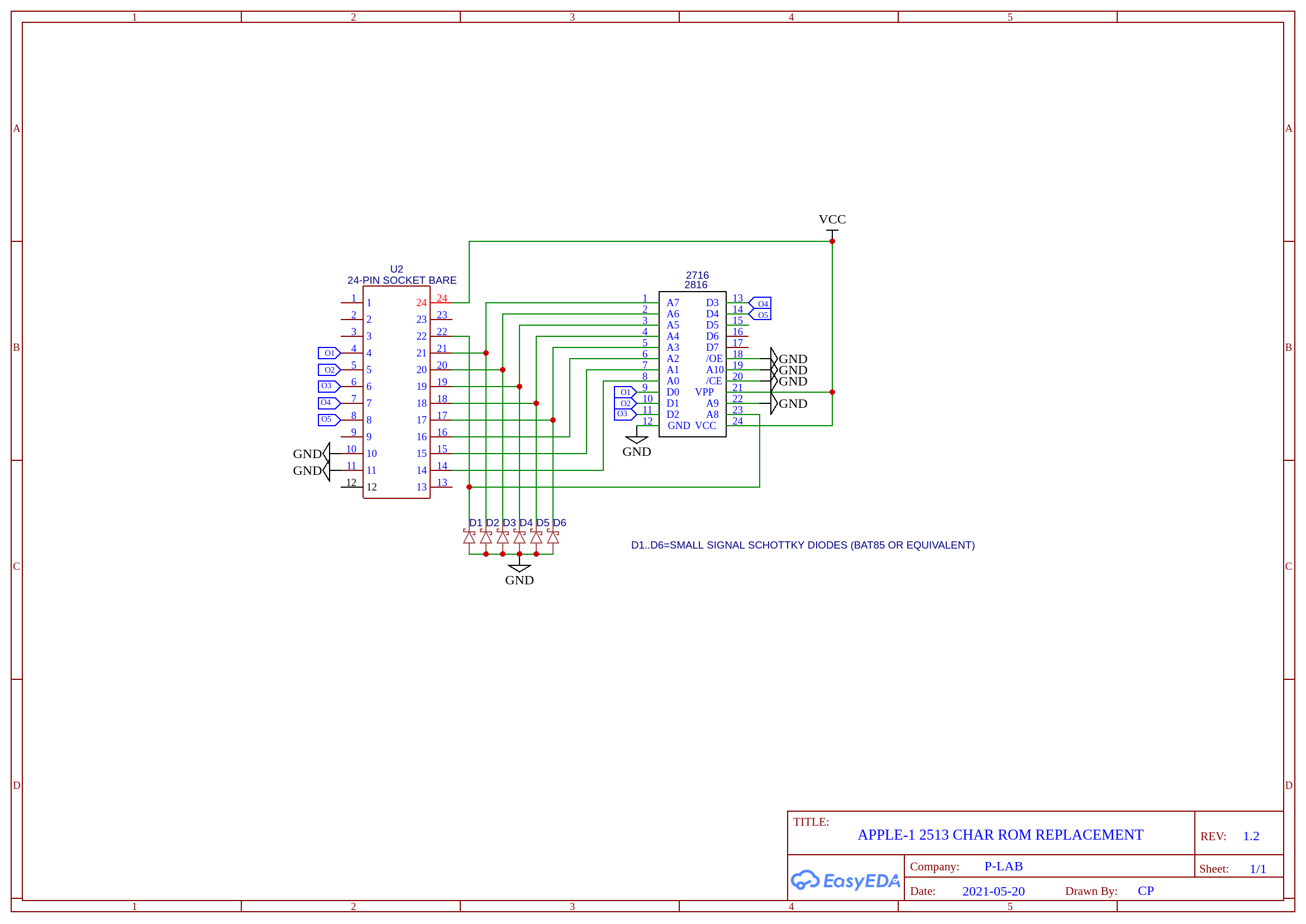
In post #3, 'natas666' wrote:
" We have quite some cases in the near past where people did not get their Apple I working, very likely because of bad or faked chips, in addition these people are not able to diagnose properly as they have no clue how to operate an oscilloscope or logic analyzer. "
Uncle Bernie comments:
Hobbyists who "have no clue how to operate an oscilloscope" are well advised to stay away from building Apple-1 clones, except when using 100% tested and burned-in IC kits. My general take on this topic is that attempting to build any complex electronics project without having proper lab instrumentation is the same as "flying blind", which, in aircraft, and with no instruments, or inop instruments, or no IFR qualification, is deady (aka suicidal). In the case of futile attempts to build an Apple-1 this does not mean death of the builder but the financial loss of close to US$1000 in wasted components and a huge hit to the self esteem. So, don't do it if you lack the skills or the instruments. The skills can be learned and the instruments can be bought but this will take time and experience gained with building less complex projects, until you are ready to build an Apple-1. Which is one of the most difficult projects an electronics hobbyist can dare to do.
'natas666' also wrote:
" I know how you stand to these people that did not buy fully tested and burned in set of parts from you or an other reliable source of Apple 1 kits."
Uncle Bernie comments:
Oh, I actually admire these "Maverick" Apple-1 builders for their boldness daring to source the ICs helterskelter from dubious sources here, there and everywhere ... especially if Chinese counterfeiters are the "source". And if you have followed their whining here on on Applefritter about their difficulties making their Apple-1 work, you might have noticed I gave them some hints, and some of these mishappen Apple-1 then eventually did work - after a lot of debugging time was spent.
Here is a little "confession": it took me several weeks to make my first Apple-1 build work, and I am a retired professional IC designer with more than 50 years of experience in designing and debugging digital and analog electronics, and I have a very well equipped lab with various oscilloscopes, logic analyzers etc.
But after my initial "success" yielding only a wonky machine which did crash all too often and would not load programs back from tape, it took me several lab sessions spanning over months to find out why it was so unreliable and to develop remedies for that, all of which I have published here on applefritter. (I lay claim to the title "The man who fixed the Apple-1" ;-)
Now, how are the odds for a typical hobbyist who just learned to solder ? With no professional background ? When using an IC set containing a few bad ones ? And no oscilloscope ?
I think from my professional background I can state that the odds to get a working machine under these conditions are very slim. Those "Maverick" builders who did succeed under these conditions were incredibly lucky - like winning the lottery.
ABOUT THE KITS
What my kits did is to take the "lottery" risk away by providing a 100% tested and burned-in IC set, and hand selected timing components around the 74123 (which otherwise requires an oscilloscope to get on target). So, if the soldering was up to standards and no components were put in wrongly, build success was practically guaranteed.
It is really bad that my kits have been sold out for many years now, but this is how it is ... I just wanted to liquidate my Apple-1 IC stock to get my money back (you might know the story that these were bought for my wave-soldered Apple-1 project which was killed by the pandemic, but Armin of Munich picked up the ball I had to drop and you can still buy wave soldered, professionally manufactured Apple-1 clones from his company, with full functional warranty, and despite of his expensive prices this may be the best way for less experienced hobbyists to get a fully functional Apple-1 clone - you have to weigh in the risk factor if you try to build it yourself from unverified components, and it's always better to pay a premium price for a professionally made product having warranty than to lose close to US$1000 on components wasted on a botched DIY build which never works).
And it may be possible he also brings equivalents to "my" IC kits back, but if so, his kits will have a more professional packaging and will look nicer. The details are t.b.d. - but be aware Armin's kits, if they ever appear, will be much more expensive than the mine, which were sold at cost, and the prices for the critical ICs (2504, 2513, 2519, DS0025) have exploded since Y2019, when I bought them.
So, there is hope that 100% tested IC kits for Apple-1 builders will come back. The 100% test means that no oscilloscope is needed ;-)
THE FUTILITY OF SIMPLE GO/NOGO TESTs
'natas666' also wrote:
" A passed test would basically only say the chip is generally working with a high likelyhood it will also work in circuit. "
Uncle Bernie comments:
This is a fallacy, at least for the Apple-1 case. It has been my experience that more than 50% of the "bad" ICs I fished out with my test and burn-in procedure were not really "dead" but had a large spectrum of weird behavior patterns which manifested themselves only after warm up, or under specific conditions ... this is why my 'diagnostics page' which came with my PROMs has this peculiar way to cycle through all the available characters in a "diagonal" pattern. Some 2504 would produce a bad character at a specific condition (which would then scroll up as the test progresses) and this may have been the "pattern sensitivity" these PMOS shift registers are notorious for.
You should keep in mind that ALL these ICs once did pass both the wafer sort test and the functional tests after packaging (back then, true parametric tests were typically only done on a sample basis). Commercial grade ICs were not tested over temperature (military spec ICs were).
So what are your odds with a simple tester that can't do parametric tests ?
It will be able to fish out ICs which died while sitting for 50 years in a warehouse or died from ESD while handling or never were the IC they claimed to be (Chinese counterfeits).
But if an IC passes this simple test (which I think is likely to be less sharp than the EOL functional test once done at their manufacturer) than what guarantee do you have that it will work in an Apple-1 ? With all the ringing signals and ringing power and ground rails ?
Also note that the Apple-1 runs some of the ICs close to their maximum rated clock frequency. Which makes them hot (well documented by thermal images here on applefritter in other threads). Will the tester you propose do the same ?
ON THE NEGATIVE VOLTAGE PULLDOWNS
'natas666' asked:
" @UncleBernie would not it be better to pull the outputs to GND ? that would prevent a negative voltage on the TTL device connected to the 2519. "
Uncle Bernie answers:
In general, you should always follow the datasheet of the IC in question and adopt the applications and test circuits shown there. If you deviate from these circuits recommended by the manufacturer of the IC, then all bets are off. The pulldowns to negative voltages may be necessary to make these ICs work at all (but I did not experiment with this - I prefer to follow the datasheets and application notes of the IC manufacturer, which, believe me, saves you from lots of grief and loss of time).
And in the case of the Apple-1, you should also test the IC in question with the same circuit it sees in the Apple-1 itself, which is the application for which you want to find out whether the IC works with it.
CONCLUSION
You can see, it's not a trivial exercise to design and implement all these tests. This again rises the question if it is worth doing. Where are the benefits ? Will the realized tests on that "backbit" tester really fish out enough bad (or limping) ICs to significantly increase the odds for Apple-1 build success ?
I have my doubts, and I gave you the reasons why. But you can prove me wrong ;-)
- Uncle Bernie
FOOTNOTE ABOUT THE USELESSNESS OF LOGIC ANALYZERS FOR APPLE-1 DEBUGGING
I would not consider to take a logic analyzer to an Apple-1 debugging session. It's just too much work to hook it up and to program it, and alas, most logic analyzers are ill suited to diagnose issues with poor signal integrity like ringing etc. - they might detect such a problem to be present but to really find out exactly what is going on, you need to look with an oscilloscope anyways.
In general, it has been my experience that logic analyzers are the most hated and least used instruments in any industrial electronics lab. In 40 years of professional IC design work, I might have needed a logic analyzer maybe three or four times, to debug a new digital circuit. And I had a lab technician to do the tedious set up and programming work. It may take anywhere from 4 hours to 20 hours to set everything up to start a debug session, depending on the complexity of the task and the number of connections to be made (involving these notorious micro grabbers into which the wires from the test heads plug in). Also, these wires are too long for high clock speed work (but OK for the humble clock speeds in the Apple-1).
This is why I regard logic analyzers a fad of the 1980s and early 1990s, and why they went the way of the dinosaur, and why you can buy a nice one, barely used, built in the 1990s on Ebay for $100 or less ... but nobody buys, logic analyzers don't sell. You can't even give them away because no one wants to pay for the shipping !
- Uncle Bernie
@UncleBernie thank you for you long an detailed answer.
I don't know if Evie will add that chips to her Tester Firmware.
My Idea was just to help some people struggeling.
The BackBit Chip Tester Pro V2 is quite affordable with about $200, it promises a lot, see below.
It already covers the logic chips used, 4096 DRAM, 82S129 PROMs, the MC6820/6821 and even the 6502 CPU.
I am skeptical when I read it will test a 6502 I actually do not expect much more then a NOP test to check all adresslines and maybe some simple RAM/ROM emulation to do the same with the Databus but no in deep test that checks every command.
To test the 4096 RAMs you need the tri-voltage adapter is also named DIY 4116 DRAM Adapter ans is $20 extra.
I did not tested it myself so far, but I have seen quite some positive reviews on YouTube.
What looked very interesting to me was some in-circuit testing that was done with some cable adapters but that looked quite experimental.
Manly in Europe (especially in Germany) you can find an alternative the Retro Chip Tester Professional that you can build yourself https://8bit-museum.de/hardware-projekte-chip-tester-english/
It's less compact and has less special chips on the support list. The bare PCB is 30€, with presoldered ATMega it's below 50€, all parts are about 140€.
In post #5, 'natas666' wrote:
" The Chip Tester can already test all the other chips used in the Apple I. "
Uncle Bernie comments:
No, it can't. For the reasons see my post #4 above. See, the truth is that a complete "test" of an IC would involve parametric testing of all the parameters specified in the datasheet, over the specified temperature range. For this, the industry uses testers like the "EAGLE" made by Teradyne, see here:
https://en.wikipedia.org/wiki/Eagle_Test_Systems
... which the last company I worked for had. This tester costs several million US$ and the design and development of the "load board" and the test program for a typical product we had would be budgeted at $50000, minimum. The company also has some LTX-77 production testers, which have much lower costs per hour, but these are relics from 40 years ago which were controlled by Data General "Nova" minicomputers born in Y1969, and when Data General stopped making them, our company had to replace these Novas with a PC slot card that emulated the Nova. This is called technical obsolescence ... and some clever companies made bank by providing these Nova substitutes. (I mention this because Woz self-learned digital design by attempting to re-design the Nova ... for me it's a similar story, as a young teenager I first tried to re-design the Texas Instruments TMS1000 microprocessor using TTLs salvaged from old PCBs and diode matrixes as the ROMs, and only later I discovered the brilliant design of the Nova).
Now, compare this expenditure on real, professional IC testers to these hobby grade testers you mentioned. I don't want to belittle them ... they indeed are useful and for the cost of one hour on the "EAGLE" (includes the hourly in company rate of the test engineer who runs the machine) you can get one of these hobby grade testers. Fine. They are a tremendous value for the buck.
But they never can do parametric testing. And this is what you would need to declare ICs to be "fit" to work in an Apple-1.
Sorry that I might have shattered your illusions. But this is how the real world is. In the realm of semiconductors, nothing is cheap. Everything is ridicolously expensive. I have a whole pile of groundbreaking, superior analog IC designs which never were built because nobody would want to spend the money to develop them, including me !
To be a happy electronics hobbyist, you need to understand the true hi tech / hi cost / hi risk nature of the game ... to avoid engaging into ventures / projects you simply can't do as a hobbyist (or as a one man show, like me).
This is why I spent the time to write up all these facts you can find in the above thread. I wanted to show the reader the reality, take away the delusions, and also point to viable alternatives.
- Uncle Bernie
I tested the ds0025 on the breadboard with a signal generator and a scope - thats very easy.
The 2513 charrom is easy to test in a chip tester pro.
I tested the 2519 with external -12V (-17V to the +5V) supply in my Topmax programmer. I wrote a test program that shifts a bit through all 40 steps.
The input levels and speed will not be tested, but the main function of the chips!
Topmax-2519-Test.png
@unclebernie you shattered nothing I'm fully aware that a pocket knife with lots of tools can not replace a fully fledged toolbox.
But as you said yourself such a Tester can be useful for an hobbyist and offer quite a lot for the money.
And yes as wrote earlier you can not test any chip as 100% good as only the logic function but not the electric parameters have been tested. Almost certainly the logic functions have not even been tested with half of the maximum load that is allowed per pin.
But the tester will quite reliable identify fully broken chips, chips with broken ports and in many cases Fake Chips.
None of the mentioned testers mentions if it can bring RAM chips to the timing limit and can report an estimated access time from the tests done.
I am absolutely with you that the Pro or Professional does not belong in the name of both testers.
As it implies features that these devices do not have, what makes people think that these testers offer a comprehensive test what they are not doing.
And chips tested good can easily fail under load conditions or even after warming up a while.
I am very happy you are spending your precious time to share your large amount of experience with us.
@vossi that sound interesting but looks like it works only with a quite old MS-DOS software and this specific programmer.
@natas666
The Pico dram tester from Eric Schlaepfer (tubetime) now tests 4027 at full speed.
But the best test of all these mentioned chips is in an Apple1 board ;)
Christian