

Hello everyone.
Yesterday afternoon I was working on commissioning my old Apple IIc. After a few years of total disuse I decided to clean it using a degrea degreaator product. To do this I completely disassembled all the pieces of plastic so as not to wet the boards.
Unfortunately, a couple of minutes after the monitor was turned on, it happened that a polyester capacitor in the power supply part exploded. I found electrical diagrams about the monitor. My first question is this: the electrical schemes refer to an A2M4090 model monitor, but I live in Italy and for obvious reasons my monitor is a European model whose acronym is A2M4090Z. Are there substantial differences between the two models or the electrical schemes of the first are fine for the second?
The polyester capacitor exploded in the manual corresponds to the C772.
Can the fact that it exploded correspond to an age-related problem? Did the same thing happen to any of you?
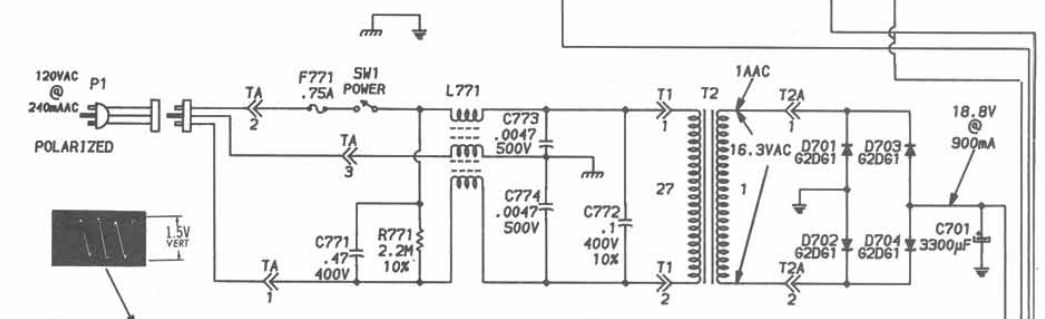
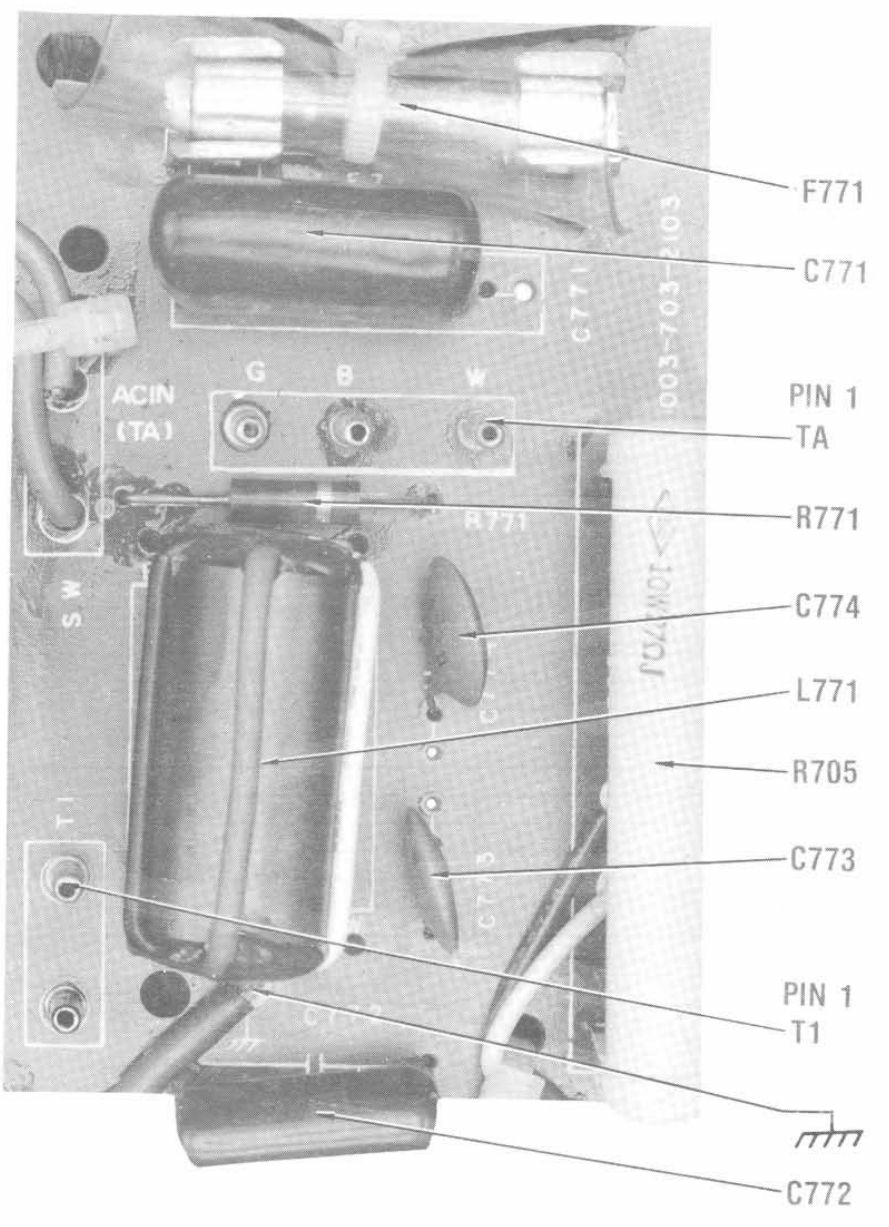
Everything on the DC side of the circuit should be effectively identical; on the AC side, it isn't, as you are on 240VAC/50Hz, and the US design is 120VAC/60Hz. Exactly which cap popped on you? C771? or another of them? What are the ratings on C773 and C774 on your board?
They should be identical, and C771 should be a factor of *100 farads compared to C773/C774. Try to post photos with a lot of detail of the damaged area and of the entire power board.
It's not uncommon for the caps in any old CRT to pop after 30-40 years.
c772 3.JPG
-----
Hello.
Here there are some other pictures.
image1.jpeg
image2.jpeg
image3.jpeg
image4.jpeg
image5.jpeg
image6.jpeg
image0.jpeg
Greetings to Italy !
Like already pointed out by Timelord, these RIFA capacitors often pop up after a while. They are line filters.
There are plenty of cases inside PSU (Apple II or monitors or any other equipement). You have to replace the X capacitor along with all the others RIFA filters (the two 4700pF Y capacitors).
And I don't think T1 connector is polarised since it is driven by Alternating Current.
Ciao! :-)
Just to add and emphasize what was already said: yes, it's very common for filter capacitors to fail after years of service - and they are easily replaced. However, just as a warning to anyone not familiar with those filters: make sure to replace them with a matching type. Not just considering voltage and capacity as usual for other capacitors. But also considering the respective "X2" or "Y" safety class rating - since they are connected to live voltage. Replacing with capacitor of a mismatching safety class will not make any difference at first. But it may make a major difference one day when time has come for this capacitor to fail: X2 and Y class capacitors will fail differently (and a capacitor of mismatching class results in an electrical hazard...).
Here is the part that you need.
KEMET PMR209MC6100M100R30, or equivalent.Hi there,
my IIc monitor failed yesterday with some smoke and power led off.
I still need to find time to open it and understand what happened but... did you solve it? and where did you find the correct replacement caps in Italy? thanks in advance :)
The thread you're replying to is over a year old.
These metallized-paper capacitors (not poly film as many have said) are still being made, despite their terrible reputation.
The small ones are Kemet (formerly Rifa) PME271Y447M, and the large ones are PME271M610M.
It would be advisable to replace them with a safety-rated film cap, as those don't blow up in clouds of smoke.
To make the replacement fit, match the lead spacing (LS) of the originals. The small caps have LS=10.2mm, the large one has LS=20.3mm.
You can order from www.digikey.it or www.ttieurope.com.
I have a IIc monitor where one of these capacitors blew up very recently.
As robespierre says you can still get them.
Living in Denmark I found a local electronic website https://elextra.dk/ where I could order them.
I decided to replace all 4 of them.
To find them use the website's search box and type in the part number, eg. PME271M610
I made a list of the rifa capacitors which are in my IIc monitor.
C771 PME271M647 RIFA X 0,47uF 250V 25mm 1,9mhz
C772 PME271M610 RIFA X 0,1uF 250v 20mm 4,9mhz
C773 PME271Y447 RIFA Y 4700pF 4,7nF 250v 10mm 21mhz
C774 PME271Y447 RIFA Y 4700pF 4,7nF 250v 10mm 21mhz
Check that the capacitors in your monitor are the same or different.
Try to find a local website where you can order them, so you don't have to pay a lot for shipping.
Polypropylene (PP) film replacements for the smaller 4700pF cap would be
Kemet R413F1470
or
Epcos B32021A3472
both are Y2 rated, as required, with 10mm lead spacing.
There doesn't seem to be a direct replacement film cap for the PME271M610 with both X2 rating and the same lead spacing. But you can always bend the leads if necessary to make them fit.
Polypropylene replacements could then be
Kemet R46KI3100
or
Epcos B32922X2104
both are X2 rated, as required, with 15mm lead spacing.
P.S. Am I the only one to notice that the schematic in the first post is wrong? Look at the diodes!
Hi there, same story, smoke! and of course i want to have my first computer back.
I understand from the post that schematics are available.
Any chance you could kindly share it or point to where you found it?
THANKS A MILLION!
The schematics the image was taken from are for the 120V version (not the 230V version with "Z" suffixed). As I mentioned in post #11, it also is not without errors.
You can search for schematics like this by putting the part number inside quotes and adding filetype:pdf.
Thank you!