

(First of all, I can't believe I've been a member of this forum for almost 21 years!)
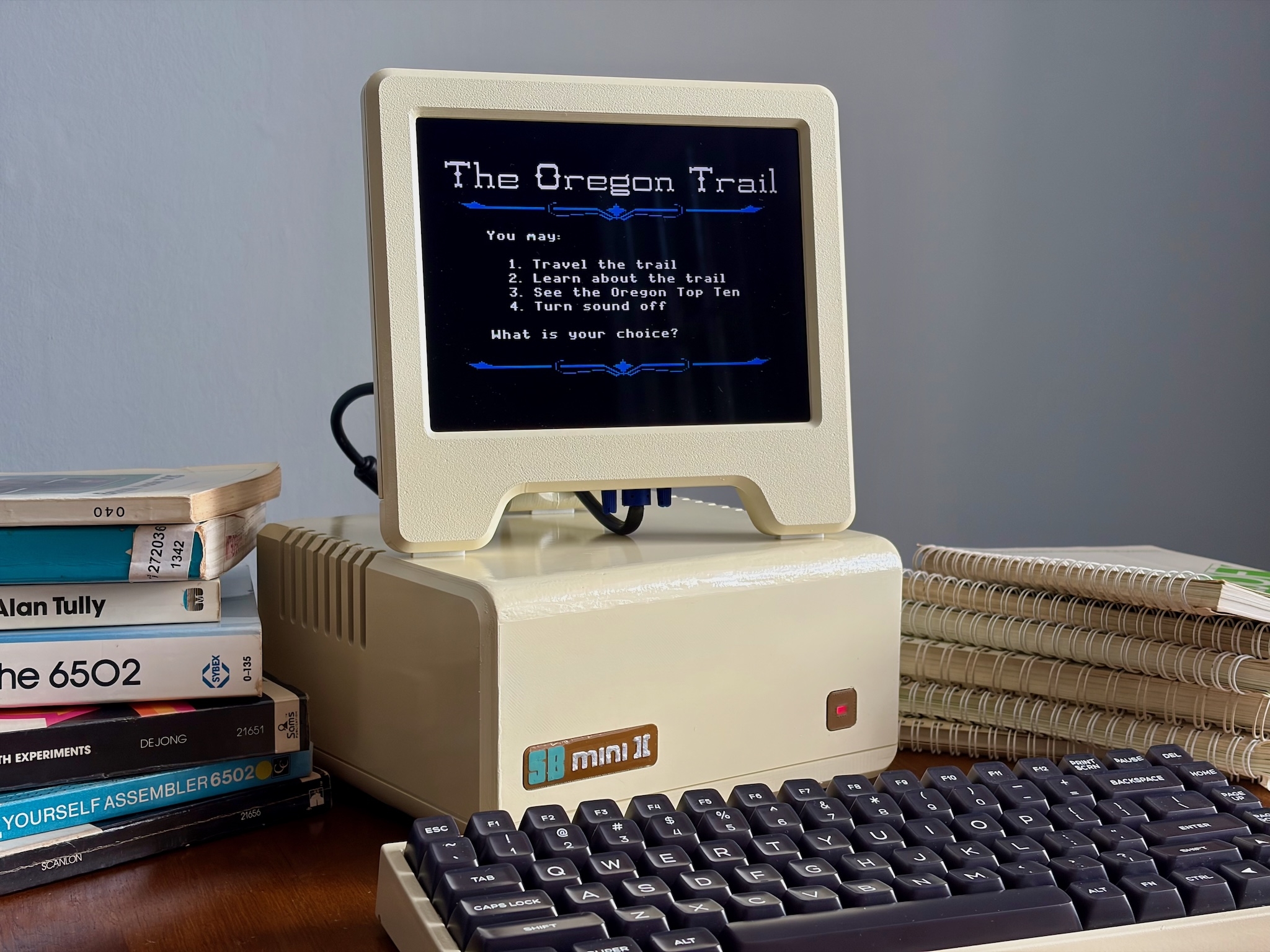
Haven't posted in a long time but since this forum was such an early influence for me I wanted to share my project. I have a real Apple II Europlus, but it's a bit bulky and not 100% reliable. I dreamed of something neater and simpler that I had a better unstanding of.
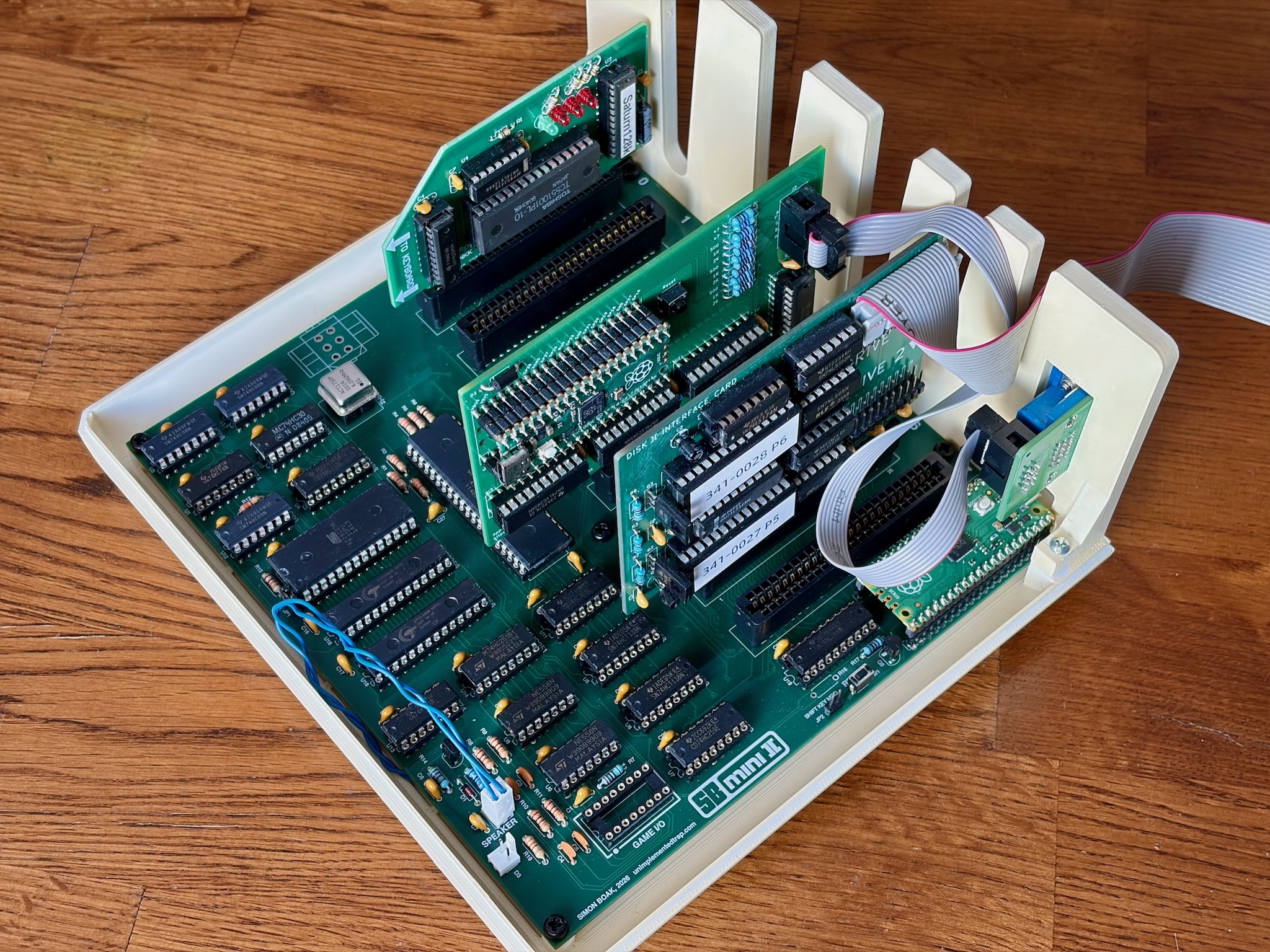
With the Apple II VGA card I reliased that took away half the complexity of an Apple II - really all you need is the 6502, enough RAM, the ROM in the right place, and a few chipd for address decoding and you've got a compatible Apple II clone!
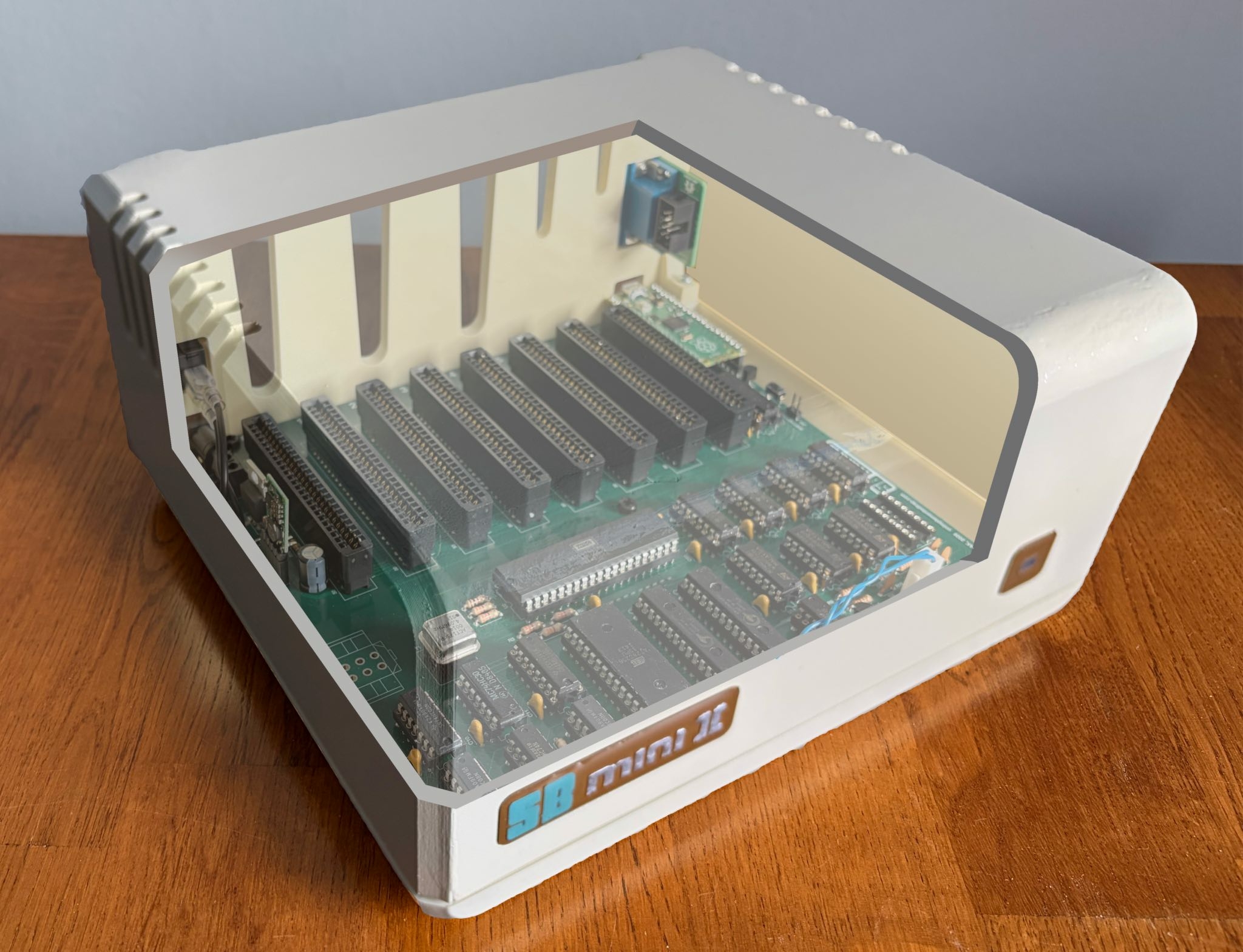
Here's some pics of my project. I've published all the files on GitHub too if anyone's interested.
A lot of effort and a very good project as a comunity member thanks for all the hard work.
A very clever idea and exceptional execution! Thanks for sharing!
And if you have an extra PCB could I buy it?
Fascinating project. I bet it wouldn't be too much harder to do a //e clone that way.
Sure, PM me and we'll see what we can do! Postage will be from the UK though...
Someone has, and they published it right here ;) https://www.applefritter.com/content/uncle-bernies-replica-2e-ww-prototype-apple-iie-replica
Very neat and beautiful project! Congratulations.
Yves
I have communicated with Uncle Bernie on numerous occasions. I would love for his project to reach release soon, but it is still in progress. There is no PCB you can get yet. When it does become available though it will be something great.
This is super cute and I want one. Probably can't afford it, but still...
Does anyone have a source or part number for an Apple II-compatible power supply connector? (The 6-pin male part that solders to the mother board.)
I found a couple at Digikey, but the shroud doesn't look right:
molex 0039281063 (Digikey WM3802-ND)
Amphenol Minitek Pwr 4.2
vertical TH header 10127820-0622LF
Digikey p/n 609-6273-ND
Thanks
You may have a look at DigiKey Part Number A14207-ND.
The plug ist listed under A14113-ND.
Thanks for the part numbers. Certainly looks right - I'm just amazed that the socket is $14 each.
Very well done project. Truly inspiring.
Cool poject, nice work!
This is a great project, and very similar to what I was thinking of doing before I ran out of time and enthusiasm! :) Having a well thought out and proven design has rekindled my enthusiasm.
Extra kudos for making it public and open, with the design files also available in an open format (KiCad!), rather than something expensive like Diptrace or Eagle.
I've downloaded the project and taken a look, and it's very clean, which is great.
I have a couple of questions:
1. Have you tried overclocking it with a faster crystal? If so, how fast did you go? Obviously it would break compatibility with some software, but an 8Mhz Apple II would be pretty cool. Even better if there could be a selector switch for 1Mhz and then turbo mode. Even better again if it could be switched on a key combo using the Pi Pico.
2. If I wanted to remix it into Mini-ITX format, I think it would require removing one of the slots, as ITX is a bit narrower than your board. Which slot would you recommend to remove?
Thanks!
In post #16, "nrrd" wrote:
" Have you tried overclocking it with a faster crystal? If so, how fast did you go? Obviously it would break compatibility with some software, but an 8Mhz Apple II would be pretty cool. "
Uncle Bernie comments:
I do have some doubts about the "coolness" of such a scheme, as I ran my Replica 2e prototype with up to 20 Mhz CPU clock speed, using one of the WDC 65C02S I have bought a tube full many years ago. These are rated for 14 Mhz max clock speed but if you keep them running cool and if you have a fast SRAM, there may be more in it. The mine worked fine at 20 MHz, and might work even faster, but I did not try that. If the process node WDC used is 0.6 um CMOS (which I just guess), these CPUs should be able to run at least at 100 Mhz CPU clock speed, if logic synthesis was set for that target. But this would make no sense as there is no 5V capable off-chip memory being fast enough for that CPU speed.
Downsides of Apple II overclocking
Although the 20 Mhz speed is fantastic and Applesoft BASIC demo programs run fine, the higher clock speed breaks almost all peripheral / slot cards, especially the all important DISK II system. This has nothing to do with the slot bus speed (on my Replica 2e, the slot bus still runs only at 1 Mhz even if the CPU runs at 20 MHz, and the graphics system also only runs at the original speed). The problem is rooted in the "cycle counting" based RWTS. Which breaks if the CPU runs faster than 1 Mhz. This was the deadly trap in the Apple II architecture it had from the beginning. This is why Apple never was able to make the Apple II run any faster, due to all the legacy software based on cycle counting. While competitors using the 6502 got faster and faster (and went out of business anyways ;-).
I've tried a concept with automatic slowdown to 1 MHz CPU clock when the disk drive motor runs, but for some reason DOS 3.3 does not work with this concept, although plain assembly language test programs I wrote (knowing about the speed switch) do allow to read the disk using the standard RWTS, once the disk drive motor is turned on and the speed reduction kicks in. I had no time to investigate what needs to be fixed in the DOS.
At the moment this project is at the back burner, but I intend to reactivate it when I've completed my ongoing Apple-1 projects. Even for retired people like me, there are only 70 hours of active time per week, so I can't do everything I want to do. So many projects, so little time ...
- Uncle Bernie
P.S.:
For those who are interested, the Replica 2e thread is here:
https://www.applefritter.com/content/uncle-bernies-replica-2e-ww-prototype-apple-iie-replica
But as I explained above, don't hold your breath ! There may be a stripped down version which substitutes an Apple II+ with the language card sooner. Can't say more yet, as at the moment it's just an idea to find another application for my Apple-1 graphics card. This sounds silly, I know, but it's a real issue that needs to be solved: with the "sweet spot" for ordering graphics card PCBs being 30 pcs, and approximately a dozen people worldwide (from 8+ billion people on the planet) wanting to build my Apple-1 color graphics card, what can be done with the leftover 18 PCBs ? --- If you really ponder about this, the Apple-1 world is not a "market niche", it's more like a gap in the "quantum foam", in other words, virtually non-existent and then, still existent, much as Schoedinger's cat being dead and alive at the same time, probability wise. It's a weird world we live in, folks !
@UncleBernie. Thanks for the reply. As I'm sure you know, the Apple IIc plus ran at 4MHz, but I don't recall the details of how it got around the 1MHz limit for the DISK II system.
In post #18, 'nrrd' wrote:
" As I'm sure you know, the Apple IIc plus ran at 4MHz, but I don't recall the details of how it got around the 1MHz limit for the DISK II system."
Uncle Bernie comments:
So far I was inclined to think that neither the Apple IIgs nor the Apple IIc+ are "true" members of the Apple II family, which had a distinct technical legacy / development trajectory starting with the Apple-1. In my eyes, these odd ducks - which I never owned, and don't want to own - are a completely different system architecture, with totally new capabilities, starting from scratch (a "clean sheet design") and then, they somehow seem to have shoehorned an Apple II "compatibility mode" into these new designs, which makes sense to leverage the vast software base for the Apple II family.
But I've looked only very briefly into the IIc+ and IIgs story, so I may be mistaken with this opinion. And I don't care ... for me, the "legit" Apple II family tree ends with the Apple IIe and IIc. These machines have the "technical genetics" given to them by Woz, even if the MMU and IOU are re-implementations of his concepts done by third parties.
IMHO, the IIgs and the IIc+ are not legit members of the Apple II family tree, but they are "bastard children" which came from totaly different roots.
Readers may or may not agree with me on this standpoint, and I don't want to start a discussion about this topic (it's not worth to waste time / energy on).
But just look at how the Apple IIc+ implements the floppy disk controller - an ugly wart, requiring a weird custom chip with an extra buffer RAM, why did they do this, I think Woz would never have allowed this to happen if he still had had a say on these topics. It's a mockery of his very elegant original DISK II concept. But of course, the kludge is a brute force way to get around the issues with how to run the CPU at speeds other than 1 MHz and still have disk access.
This ugly kludge alone is reason enough for me not to want an Apple IIc+ ... it's too "alien". Not "conceptually pure" either.
The computer history is full of such ugly solutions. They build electronic Jenga towers to stay compatible with legacy systems. With each generation of progress down the semiconductor shrink path, the Jenga tower gets more and more wonky and weirder and weirder. The Intel CPU family comes to mind ... 8080, 8086, 80186, 80286, 80386, 80486 ... terrible. But successful. Despite of all the uglyness and lack of elegance.
I'd rather prefer to throw all the old, obsolete concepts out and have a clean sheet design. Elegant and efficient.
But this is not how the corporate world works.
- Uncle Bernie
nrrd wrote: 1. Have you tried overclocking it with a faster crystal?
I have briefly tried this design with other oscillators. At 8 MHz (2 MHz CPU clock) it does boot to Applesoft and ran the simple program I typed in. However you can already tell something is off because the start-up "boop" sound is more like a squeak. No disk controller was attached. With a Dan ][ card installed it got to the "press return" prompt but immediately crashed into the monitor.
I also tried a 16 MHz oscillator, but at a 4 MHz CPU clock speed my (relatively) ancient Rockwell 65c02 probably couldn't keep up. No startup beep of any sort and the screen was mostly filled with "@" characters and a few random blinking things. However, since it depends on a Pico VGA adapter card, we may have just outpaced its ability to watch the bus for video ram address writes.
The operating frequency drops to 1 MHz when any disk is accessed. This is the same as the IIgs, although the IIgs hardware is more complicated because there is a mode bit that overrides this 1 MHz when software sets up the IWM for the Apple 3.5" Drive. That's because the CPU is barely fast enough running at 1 MHz to handle the 500 kbit/s data rate of the IWM in FAST mode, so the IIgs needs to run at 2.8 MHz to read or write 3.5" disks reliably.
The IIc+ has special hardware to move data to/from the IWM in FAST mode even when its CPU is running at 1 MHz. It needs this in part because the 4 MHz accelerator can be disabled when using speed-sensitive software.
In post #20, 'retro-tinker' wrote:
"However you can already tell something is off because the start-up "boop" sound is more like a squeak. "
Uncle Bernie comments:
Exactly, this is one of the nasty problems with Apple II accelerators. They break the sound effects. Other than that, gameplay may get too fast, except when the game main loop is slaved to the vertical blank period (via the "vaporlock" programming technique on older machines, the IIc and IIe had a flag for that).
In post #21, 'robespierre' wrote:
" The IIc+ has special hardware to move data to/from the IWM in FAST mode even when its CPU is running at 1 MHz. It needs this in part because the 4 MHz accelerator can be disabled when using speed-sensitive software."
Uncle Bernie comments:
This special hardware based on a custom IC is the "wart" I mentioned in my post #19. The "MIG" chip. There also is another ASIC, too.
Total number of IIc+ sold is elusive. Some source claim 200k, some claim 400k. But they are much, much rarer nowadays than plain IIc which also was not exactly a bestseller. So I doubt even the 200k number for the IIc+. Actual sales numbers could have been much less.
This makes me wonder if they (Apple, the corporation) ever recovered the costs for these custom chip designs. For the MMU and IOU in the IIe and IIc, these certainly were cost savers. But the "MIG" and that "other ASIC" ? Did they ever get back the investment ? Who knows. Back in the 1980s there were lots of 8-bit computers using ASICs (the most infamous example is the ZX81 whose Ferranti ULA just needed a sole customer specific metal mask) but most of these ASIC equipped computers did not sell enough to justify that expense. The ZX81 of course did ... they could have sold it at $50 and still make a healthy profit.
The 1980s and 1990s were filled with dubious Gate Array and Semicustom IC schemes, the most amazing one probably was ES2 who claimed to use electron beam lithography, so no masks, so you could make small production runs of 5000 pcs of standard cell ICs (approximately only one wafer needed) with them at very low cost. I did use their services for several projects. But after ES2 went bankrupt it turned out that it was a scam, as the e-beam lithography was too slow, and a bottleneck, so allegedly (as the story was told to industry insiders) they paid Philips Semiconductors to produce / finish wafers for them using normal optical mask based lithography. This of course increased their own costs far beyond the price point they claimed to be able to do using maskless e-beam lithography. So they lost money on every project. Sigh. The dream of full custom CMOS for the masses was just that - a dream. CPLDs and FPGAs filled the void later, at least for purely digital designs.
- Uncle Bernie
The Apple 2c+ uses the same MMU and IOU as the 2c does. Doesn't this ring your bell? The 2c+ is a 2c with a different floppy drive controller and licensed ZIP chip. That is this "other ASIC". One can plug a wired dongle in that PLCC84 socket in place of the ASIC and use their //c+ at 1MHz happily. Or, alternatively make a PCB with the ASIC from a //c+ and create a "ZIP Chip" that can be plugged into any Apple ][.
Remember -- the DISK II controller has been originally, and still is a slot peripheral. Thus it can be substituted with anything else. That's how Woz designed it. And they "replaced" it in //c and //c+ with IWM or IMM+MIG+2K RAM (a.k.a. Apple Universal Controller) respectively.
I do see grandpa Bernie's reluctance to like anything he hasn't invested effort to get acquainted with, or market his devices to, but, sorry, I also don't like Apple1, because it had no software base. And computer without software and perspective to has it is nearly useless.
Actually this 8086 family is elegant (8080 does not belong to this family). Back in my teenage years when I switched from Apple2 to PCs the 8086 assembly language and PC DOS were like a high level language to me! And backward compatibility in software, hardware, and knowledge was very elegant. That's why they defeated the competition in the PC market. Actually Woz understood the backward compatibility was of utmost importance and as far as I read wanted //GS to evolve further instead of Macintosh. But Apple's unwise decision lead them to deserved near bankruptcy.
I'm sorry, but the hundreds of layers of hacks and chewing-gum in the "PC" architecture are anything but elegant. Backwards compatibility is of negligible importance: there's this thing called "emulation".
I can laugh louder to your ignorance. The software emuation (alas, often buggy and partial) becomes practical and available usually when an emulating platform has much more performance than the emulated. Yes, to me the original IBM PC architecture is much more advanced, flexible and elegant than that of the Apple2.
As others have said above, I don't think overclocking can work given that it needs to be smart enough to go back to 1 MHz when accessing the disk drive and other peripherals. The other question would be how quickly can the Apple II VGA card keep up with the writes to the video RAM addresses.
As for which slot to remove, it'll depend on what you plan to connect up. Slot 7 might be one of the lesser used slots (if not intersted in larger storage options), alternatively the board could have asmall jumper area which could allow for reconfiguring which number is assigned to each physical slot. My original plan was actually to only have 4 real slots and something like that to choose their assignment.
I'm glad you put in all those slots - I'm slowly filling them all up :-)
16K language card
VGA card
Dan ][ card
Serial board
(soon) Silentype interface board
In post #26, 'Simon27' wrote:
" As others have said above, I don't think overclocking can work given that it needs to be smart enough to go back to 1 MHz when accessing the disk drive and other peripherals. The other question would be how quickly can the Apple II VGA card keep up with the writes to the video RAM addresses. "
Uncle Bernie comments:
Such a 'smart enough' solution could look at slot address accesses mapping in the 2k EPROM page coming with many slot cards, which, if mapped in, implies that the firmware of the card runs and this could be used to control the throttle down process to 1 MHz CPU clock speed. The problem with this approach is that some slot cards may not relinquish the 2k page ($C800-$CFFF) after their work is done, so the system may get stuck at slow speed. For slot cards which don't use the 2k shared page at all, such as the DISK II slot card, this concept obviously does not work.
As for the Apple II VGA card, I'd not worry too much as long as the slot bus always runs at only 1 Mhz and the CPU sits in its own "island" where all the speed-up happens. The "island to slot" interface must consist of address and data bus latches to extend the lifetime of address and data to the slots, while the CPU runs at full speed. For graphics routines, all accesses to the screen buffer memory take at least 4 CPU cycles, so up to 4 Mhz CPU clock speed does not need any wait state logic. Faster CPU clocks require wait state logic for screen buffer writes in cases where the CPU issues a new write to the screen buffer while a previous write is still pending (due to the screen buffer writes to anything outside the CPU island always being slowed down to 1 Mhz). I found that this concept does not reduce obtainable screen buffer operations speed much, even at very high CPU clock speeds, as software sprite operations do a sequence of 6502 instructions that typically do screen buffer writes at a much lower rate than 1 million writes per second. Screen buffer reads by the CPU always come from the fast SRAM in the CPU island which acts as a screen buffer cache memory. The real screen buffer memory 'lives' on the slot bus that only runs at 1 Mhz cycle time, and the video address scanner consumes half of it, as in the original Apple II.
This is how I implemented the "turbo" mode in my Replica 2e project. But there are enough issues to be solved left over, as mentioned with the 'smart enough' solution above. It is promising but still imperfect and requires a lot more refinements.
I think that any legacy CPU speed accelerator on the Apple II ran into the same problems and solved them in much the same way. As I don't have one of those legacy accelerators to investigate, I can't say which level of success they were able to achieve. I think that some slot card configurations may have worked, but others may not have worked. And the latter cases mean unhappy customers who will complain. In the industry, these troublesome products have a moniker, "Phone Call Generator", or short, "PCG". If you design / build one of those, you get fired ... ;-)
There are some truly horrendous PCG products out there, or have been out there, in the field, and the costs of the customer support hotline typically eat away all the profits the initial sales of these troublemakers made, and then some, turning the product into a loss generator.
Every industry has their own anecdotal stories about such products. And I bet that all commercialized Apple II accelerators were PCGs, with no exception. Simply because a complete, satisfactory solution may be impossible to reach at all. Think about the sound effects problem alone. The only solution I have for this is to turn the speaker port off when the CPU runs fast ... silence instead of squeaky nuisance sounds.
Maybe all these unsolvable problems were one main contributor to the poor reception of the Apple IIc+.
It's no good to advertise accelerated CPU speed / "turbo" mode to lure customers in and then let them find out which applications will still work or which won't. Customer service hotline phones sure will ring off the hook - and many disappointed customers will bring the product back for a refund. All this dooms a product.
- Uncle Bernie