
Anonymous
User login
Please support the defense of Ukraine.
Direct or via Unclutter App
Active forum topics
Recent content
Navigation
No Ads.
No Trackers.
No Social Media.
All Content Locally Hosted.
Built on Free Software.
We have complied with zero government requests for information.
...used...capacitors?What am I missing here?
In post #2, 'octo' wrote:
" ...used...capacitors?What am I missing here ? "
Uncle Bernie comments:
Welcome to the insane asylum of Apple-1 originals. Which are auctioned off for some spare change like $350000 and above by esteemed auction houses which never will touch mundane items of $100000 or below. Fact. Insanity. I always have wondered who pays these outrageous prices for 1976 era electronic artifacts which should be worthless like all other obsolete electronics.
But ... here is the fact. The Apple-1 started AAPL which today, 50 years later, is one of the most valuable companies in the world, worth trillions (!) of US$. Part of which, of course, could be also due to the diminishing purchasing power of the US$. Its purchasing power shrank to about 10% of its 1975 value, in "only" 50 years. But the same is true for any other leading FIAT (aka "toilet paper") currency in the world. There are many "currencies" which are worse, even less than as being qualified as "toilet paper", which lost more purchasing power than the US$ and its peers. If I was snarky, I'd call these other currencies "used toilet paper", but as a gentleman I don't want to go there, as it stinks.
I can remember a time where 15 cents would buy you a nice ice cream popsicle. Back then, early 1970s, we were kids and rigged fishing wire with magnets to 'fish' out coins from below vending machines which happened to be located above metal gratings protecting basement windows below them. These places were scarce but we kids had explored them all within bicycle range and made more money per hour expended on 'fishing' than with mowing lawns. Fast forward to today and it's probably not worth the energy expenditure to bow down and pick up any coin found on the pavement. The largest coin would be a quarter dollar which would buy you nothing, no candy bar, etc., nothing worth anything. It's essentially worthless and the metal recycling "melt" value soon may exceed the purported "face value" of the coin. This is why the U.S. Mint has ceased to produce pennies.
This phenomenon of "toilet paper money" may incite billionaires to buy rare artifacts which these billionaires perceive - for them - to be "cheap". IMHO this is the only force driving prices for Apple-1 originals to the moon ("moon prices"). Mere millionaires could not compete. Because being a "millionaire" today means not that you could live much better than the common riff raff. Thanks to the"toilet paper" money. In the so-called "Weimar Republic" (Germany), everybody was a billionaire. But you needed 10's of billions to buy a loaf of bread.
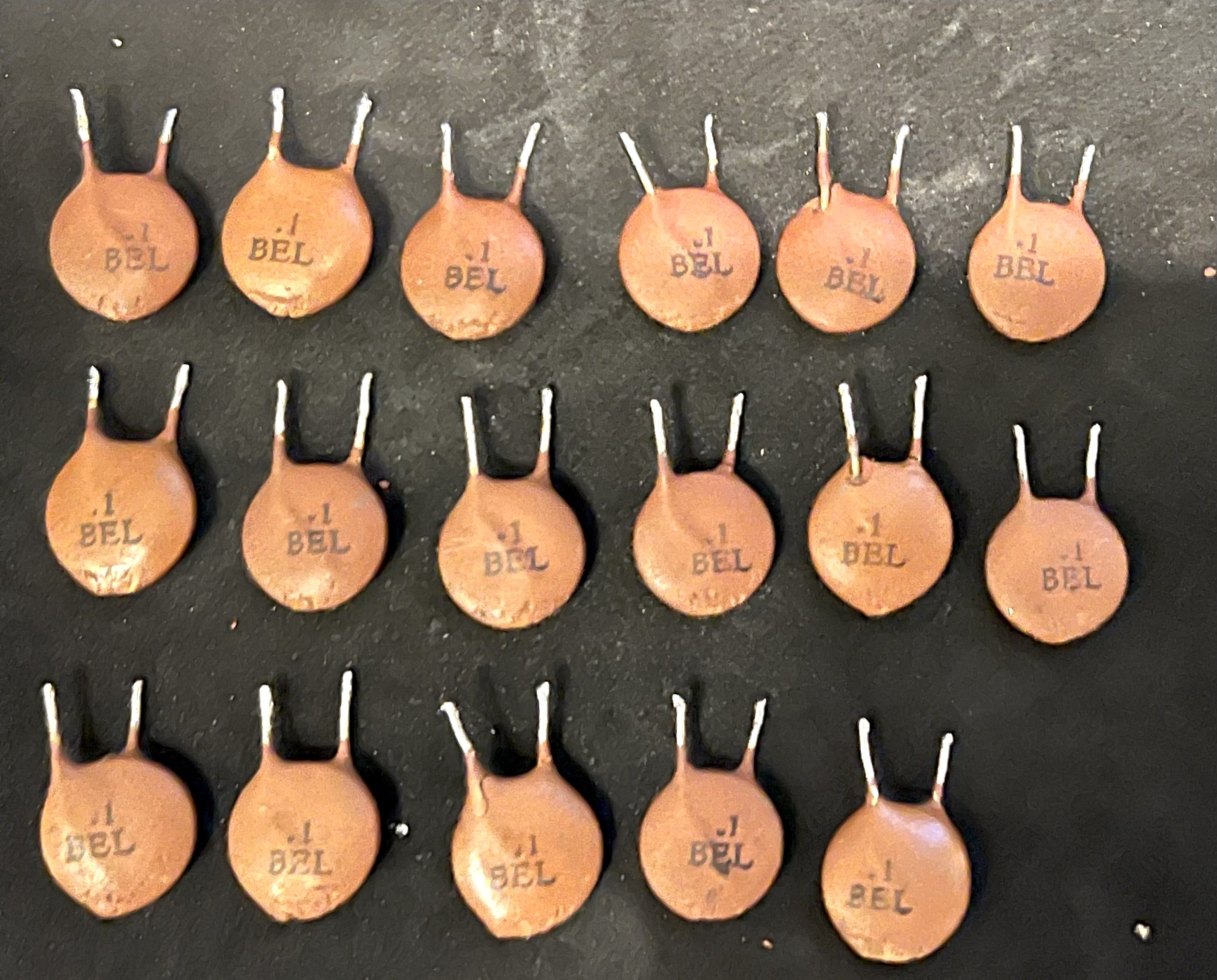
Now, some people try to make Apple-1 clones being as close to the originals as possible. Which means the use of 1976 date code ICs throughout and, if possible, the use of these BEL brand capacitors. Which were used in the first 50 (or so) original Apple-1 being built. The later originals, called the "NTI" versions, used different capacitors, IMHO to make them more reliable. But the problem was not the poor performance of the BEL capacitors - it was the ringing on the multiplexed address bus, caused by the PCB trace length exceeding the limits for Schottky TTL. Adding six damping resistors would have fixed that (see my "reliability mods") but Woz, despite being a brilliant digital designer, is no RF designer knowing about transmission line effects, so he can't be blamed for that blunder. The guy who taped the layout of the Apple-1 PCB could not be blamed either - he was just a layout technican and no one can expect RF knowledge from him at the time being. The fatal flaw of the Apple-1 has no "fathers". Had they hired a Schottky TTL design consultant, the Apple-1 may have been sound - but the fledgling "Apple Computer Company" simply had no funds for that.
But back to these BEL capacitors. Some makers of Apple-1 clones are willing to expend great effort, time and money, to get components being as close to the originals as possible. And this makes sense if the mission objective is to build a clone which is "museum grade" - as close to the originals as possible.
The psychology of "fake" museum exhibits is that most of the onlookers would not be able to tell if it's an original or a "fake". Even when being informed as to the components of originals. So "BEL" capacitors could help with the "suspension of disbelief" as it's called in the movie industry. The mission objective is not to defraud, but to make the onlooker to walk away with the impression that he saw an Apple-1 original, even if that onlooker did his "homework" before visiting the museum / exhibit. Just to give you another example: most museums worldwide exhibiting a German 'ENIGMA' cipher machine whose code breaking was the cornerstone for the defeat of Nazi Germany only exhibit the commercial version of the 'ENIGMA' and not the one used by the Wehrmacht. Still, the onlookers see it and walk away with the impression that they saw the military version, which however had completely different rotors (the fatal flaw of the 'ENIGMA' was the reflector, ironically, that was the patented feature different from other rotor machines, and without the reflector, the 'ENIGMA' cipher would have been unbreakable by 1940s technology).
For typical Apple-1 clone builders, however, this $200 price is hilarious and they would not want to pay that. Only those few who build "museum grade" clones might be interested.
- Uncle Bernie