
Hi there,
I am seeking to repair an old 'Super 5' (Ei En Enterprises) floppy drive. This is a clone drive made in Japan and based on a Teca FD54a drive.
This one may have been plugged in incorrectly a long time ago and has damage to chips on the analog board (one chip actually split open IC7).
Issue with repairing is that the original manufacturer has removed the tops and labelling of almost every (except one) IC.
Would anybody have a similar drive with analog board that you can read the tops of the IC's? I am seeking to slowly trace through the circuit from the PCB but it is challenging to follow the circuit as it does differ somewhat from the original disk II analog board.
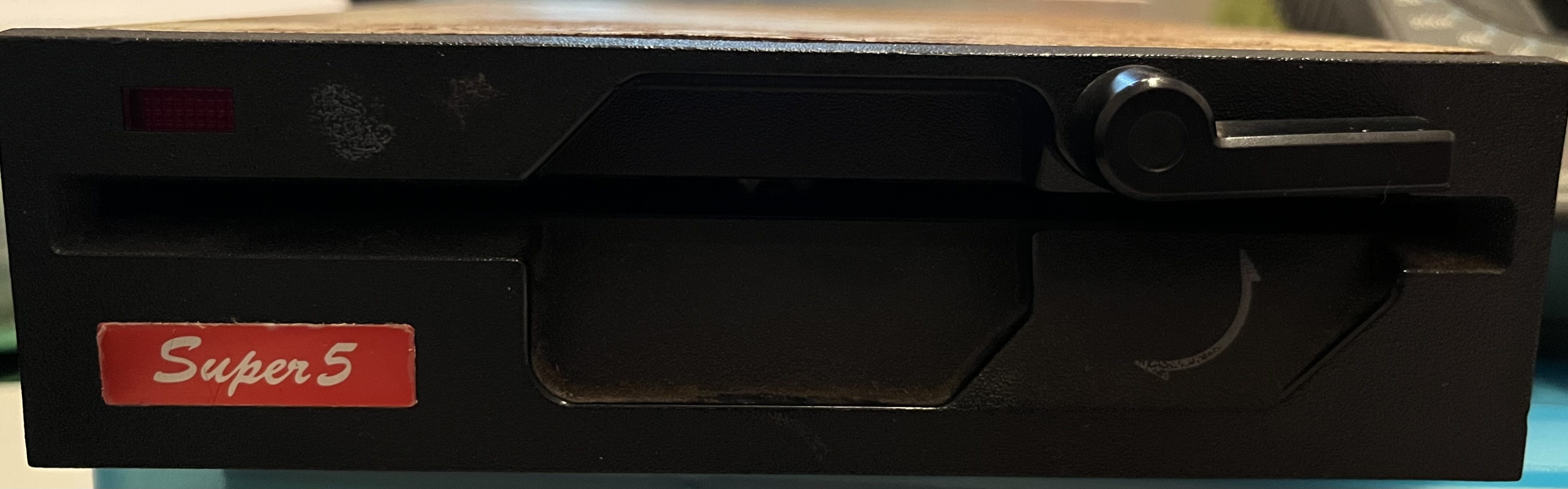
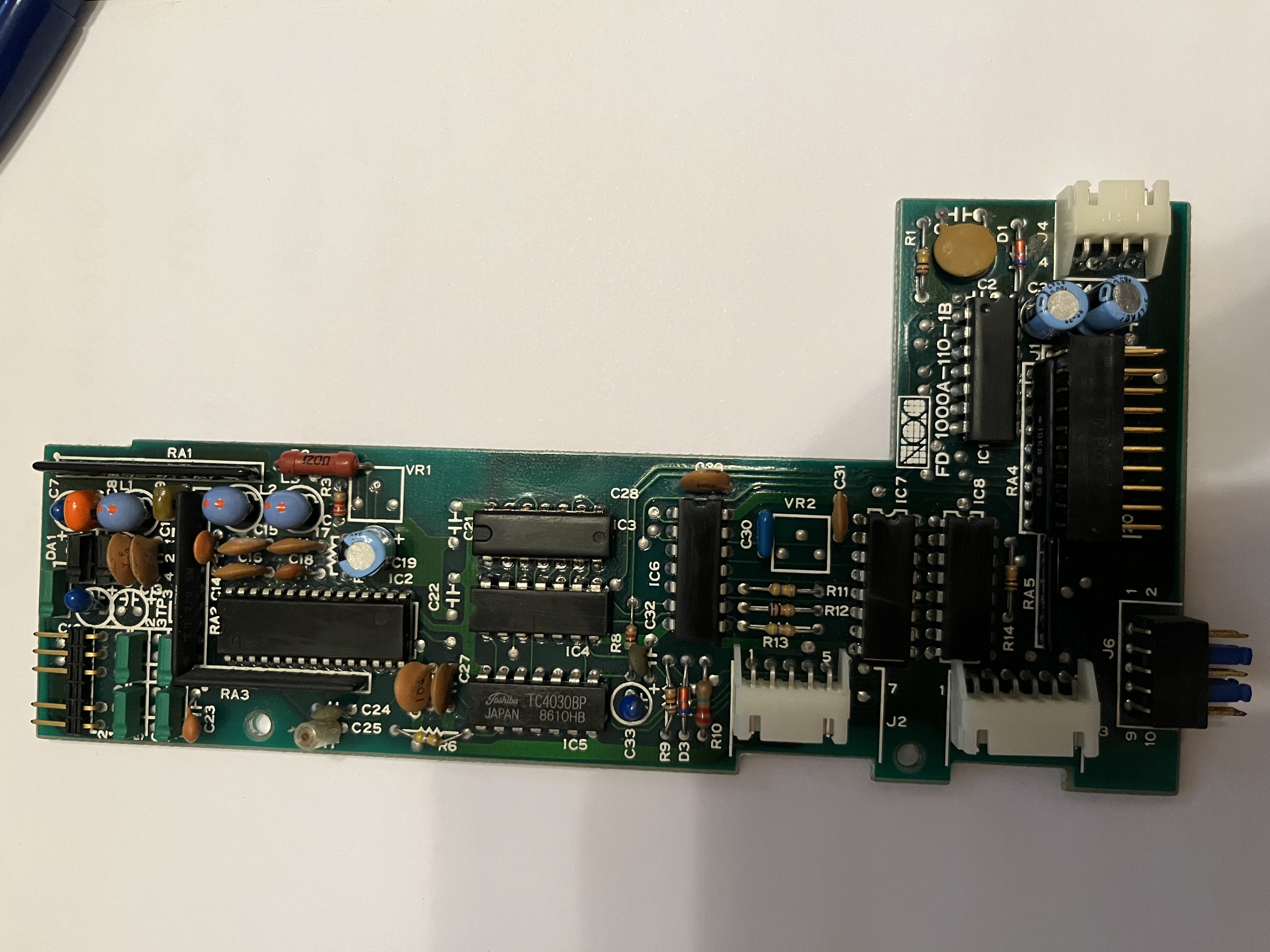
Did a little more work on this yesterday by tracing circuit as much as time allowed. Socketed all main chhips except IC2 (top of board).Made some chip replacements where i could determine original type and now instead of just running when connected and corrupting every disk inserted,... the drive can now respond to seek commands, find track zero, motor control on/off and also spins the disk for about 5 seconds every time a floppy is inserted (to allow better hub alignment when closing the drive gate).
Still does not successfully read, and there are several more IC's that I will need to identify, most importantly IC1 (bottom right hand of analog board near the connector), and IC3 (centre right of board).
Drive attached is a Teac FD-54a with chrome plated folded metal chassis (rather than the Teac FD-55 which had a die-cast chassis - some super 5 (red label) drives have the FD-55 and different electronics.
Surely some applefrittarians have been down is path before?
Here ya go
IMG_5630.jpeg
Wow, those are some weird part numbers. TC40H157P ? HD14006BP ? TC4096UBP ? Anyone got any cross compatibility info on these?
The TC and HD chips are Toshiba's and Hitachi's second-source parts for Motorola or Texas Instruments CMOS part series.
So, TC4096 is a second-source for TI's CD4096 CMOS hex inverter.
Likewise, HD14006 is a second-source for Motorola's MC14006 CMOS shift register.
TC40H157 seems to be the same as a TI CD74HC157 multiplexor.
The part numbers give it away.
Thank you Schafferm and other commenters. This photo will allow me to recover the drive. So, virtually all are CMOS 4000 series chips. I have several of these chips already in my spare parts inventory and some that I will now source. Will report on the progress in a while.
Really appreciate the photo!
On close inspection, this board and the one I have are remarkably similar but different. I sam rally appreciative of that post and photo that gives me a close resemblance and some very good clues on the 'manufacturer black topped' chips in my board but not abosolute confirmation of each chip type.
Schafferm's board (EI-EN v.1B) has an additional board connector and two additional chips, possibly with some of the others different as well. It is a later revision that supports a zero track sensor to ensure that the heads stop stepping backwards once they reach track zero.
Base drives are FD-54A in both cases, and the outside of the drives look identical, it is just that the later model is fitted with some additonal options such as the track zero sensor.
Wondering if anyone has an exact match for the (NOC 1000A-110-1B) PC board in my red label super 5 drive shown in my original post?
With the help of Schafferm's post and other hints above, I have now restored my Ei-En 'Super5' T-40 model drive (Teac 54a mechanism inside). Apparently the first time it has worked since becoming unservicable in the 1980's by the original owner.
Chips for this FD 1000A-110-1B board are as above in Shafferm's photo including IC3 (CD4001) and IC1 (HD14006BP). I am still awaiting a genuine TC40H157P so I have used a HD74LS157P (Hitachi) for now and it is working find. Will replace with it's CMOS equivalent when received.
Of the 7 IC's I removed, socketed and replaced, only the ULN2003B (IC8), 4030 (IC4) and 4001 (IC5) were servicable. All others were partially or fully inoperative including the TC40H157P which had a visible crack in it!Very satisfying to get the drive working..! Thank you everyone for the comments, hints and especially the photo Shafferm!
For documentation purposes, it would be awesome if you could take a pic of your fixed board with the part numbers showing so the next person who needs to fix one has an easy reference.
IMG_2225.jpg
IMG_2224.jpg
IMG_2223.jpg
Thanks! I am sure someone will appreciate it if they run into a drive with the same issues. I never had a drive exactly like that but they were fairly popular back in the day and I knew people who had them.
IMG_6648.jpeg
I have a "Super 5" drive that looks exactly the same as yours, so thanks for taking the time to document the parts.
My drive is still working (as far as I know) however with vintage electronics you just never known when things are just going to develop a fault.
The paint job looks great too. Well done on a nice restoration!
Cheers,
Mike
I love it when there's a resolution to the issue and it's followed up and posted by the orignal author.
Thanks. Definitely the exception.
That's one of the great things about this site, is how often solutions are posted. So many other places you see questions asked and even occasionally someone will post a "I got it fixed" but not share the answer... I always try to encourage people to follow up, ideally with pics so that others can benefit from it in the future. It is suprising how many google searches for something Apple related the answers are found here. I often link to threads here from other sites when people have questions I've seen answered here before.
Thanks everyone for making this a great discussion with comments and help.
A couple of extra notes for the thread that I discovered whilst researching these drives.
Super5 was the brand of Ei-En Enterprises - a Japanese company based in Ebisu, Tokyo that sold drives for the Apple II during the early / mid 1980's.
There are several varieties sold and are distinguished by the colour of the super5 label on the drive. (Other differences in gate mechanism and features also noticable). All drives are capable of 40 track operation.
super5 ad-44348350_10215832403995510_6976167120916709376_n.jpg
IMG_6686.jpg
IMG_6687.jpg