
Over the past five years, I have built more than a dozen Apple-1, mostly driven by the need to verify the validity of my "Tips & Tricks" pdf for builders of my kits, and proof for the viability of these kits themselves.
Despite I sold off a few to "thin the herd", the peak number was around 16 specimen, now down to 14.
But there is one particular build which I like most, and it's a "keeper":
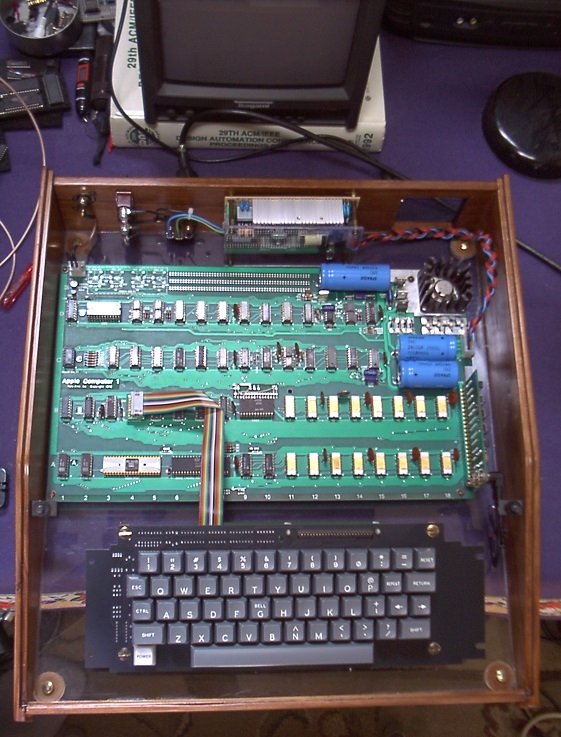
The curved lid and the bottom are made from Perspex (aka Plexiglass) so each side of the motherboard can be examined. Alas, I had to remove the lid for this photo to avoid the glare. But in natural light, with human eyes, the glare from the Perspex is no issue. Only in still photos, glare manifests itself as a nuisance. Seems that the human eye can unsee what the camera sees. A professional photo studio could avoid glare, too, but even for professional photographers it's tricky.
This Apple-1 clone was built on a Newton non-NTI PCB using machined contact IC sockets, and is populated with ICs which mostly have "correct" Y1976 date codes. Although I do have a set of original Stancor transformers, I decided to power it with a modified "Mean Well" switchmode power supply, just to keep everything running cooler and to avoid fans.
The keyboard is a "YAAK" keyboard which I designed for this purpose. IMHO, use of old Apple II keyboards is not a good choice for such a build (which was quite expensive due to the Y1976 ICs and the custom enclosure). If I spend a lot of money on such a thing, I don't want an old and unreliable keyboard in it.
More info on the wooden enclosure:
The wooden enclosure was custom built for me according to my specs by an Applefritter member who lives in Montana / USA. He is a true craftsman with a well equipped woodworking workshop and he listens and is very flexible (you could even specify Koa wood or other exotic woods, but may need to wait for these materials to arrive).
This enclosure was not cheap but it's worth every penny. It's true eye candy ;-) . . . every guest in my house so far was totally stunned that a "vintage" computer can look like this.
I even did a Jedi mind trick telling them it's a real Apple-1 I bought for half a million dollars, and those in the know started to look at the date codes and were speechless. Of course, being a honest guy, I then told them it's a hoax. But this little experiment proves how far the art of making "fake" Apple-1 "originals" has progressed. I duly compensated my "victims" of this hoax by serving them a good dinner (I'm a good cook) with some excellent French wine and Champagne from my cellar. And we had a good laugh at the hoax. (Several high quality builds based on my IC kits are on display in computer museums worldwide, pretending to be an original).
Difficult to photograph !
Sorry that the photo above does not do this masterpiece of woodworking any justice. I don't have a professional photo studio and I use a Y1998 Toshiba PDR-M4 digital still camera (I have three of them). I'm not going to invest in a good mirror reflex digital camera because I know that I won't get any reasonable use out of it ... the dirty little secret about professional quality still photography is not the camera and lenses price, but the 10 x amount spent on the studio and the lighting systems. A few good "daylight" floodlights can cost more than the camera - each. And you need several of them to avoid shadows. Even professional movie productions rent their lighting equipment because it's so heinously expensive to own.
My philosophy is to either do it cheap, or, if I can't do it on the cheap, I do it with the best equipment money can buy. Anything in the middle typically turned out to be not good enough but still too expensive for what I can get as results for the extra expenses.
This conundrum always has been the dilemma for those who want professional quality results from anything. This rule even extends to lab instrumentation. Or to musical instruments. Or whatever.
The cheap solutions are one extreme but still might satisfy given the "bang for your buck".
The top notch solutions will always satisfy if the operator has the skill set.
But everything in between always is a compromise - so renting top notch equipment may be the better solution towards best results. But renting equipment needs a business case not found in our hobby.
Want more photos ?
So, sorry, you can't get better photos from me. But if you want more photos of the same poor quality, showing details, just comment, and ask for them. I will take them and post them when I have the time to do this. Maybe this inspires some Apple-1 builders to put their builds into similar wooden enclosures.
Comments invited !
- Uncle Bernie
I hope you enjoy your enclosure! I was able to capture a few pictures of your case before I sent to you. The board is one of my builds on a Newton board with your famous chip set, YAAK keyboard, switch mode power supply and your Gen 2 ACI. The wood in this one is African Teak with a Lexan top and bottom.
IMG_8831 3.jpg
IMG_8828 2.jpg
IMG_8827 2.jpg
IMG_8829 2.jpg
I am currently buiding 2 made out of Koa with anothe of your chipsets, Gen 2 ACI and YAAK keyboard.
Here are a few others I have made from Koa, Walnut and Lexan.
IMG_8013.jpg
IMG_8012.jpg
Thank you for all your help for buildig these Apple 1's Bernie!
IMG_8834.jpeg
In post #3, 'linuxha' asked:
" Which model power supply did you get ? "
Uncle Bernie answers:
It's a "Mean Well" PT-45B switchmode power supply which I modified from the stock +5V/+12V/-12v outputs to +8V/+15V/-15V and it feeds the unmodified power supply rectifiers and regulators of the Apple-1. This avoids the "direct feed" method which needs added thick wires to bypass the regulators on the motherboard. These added wires look ugly and should be avoided if the bottom of the enclosure is transparent.
I posted about these mods somewhere on Applefritter but can't find these threads right now - you can look for them. Here is a short overview:
"Direct feed" was the only way to run an Apple-1 cool until the "Mean Well" mods have been developed. I don't recommend "direct feed" anymore because it requires selected regulators to avoid regulator damage due to the feed voltages applied on their outputs. Not all regulators from all manufacturers tolerate that, it has to do with the junction isolation and the substrate material being used (big differences, some use Epi wafers, others don't).
The regulators on my kits were chosen to be able to sustain "direct feed" but some "maverick" builders not using my kits ran into difficulties and damaged their regulators which were sourced elsewhere. I had tried to prevent this by not publishing "direct feed" details on Applefritter, but then one of the builders of my kits spilled the beans on youtube, which incited "maverick" builders to try it with regulators not tested to be fit for it. Bad karma ! Don't do that !
The modified "Mean Well" power supplies are the better alternative but I did not publish the modding instructions as I don't want to have some dead bodies (electrocuted) of bloody amateurs piling up all around the world. I furnish the instructions only to electronics professionals who do have the required experience and safety training for working on exposed line voltages. If you qualify, send me a PM.
Note, however, that "Mean Well" recently changed the PT-65B PCB to include more SMDs for cheaper manufacture. For this new version I don't have any modding instructions. I don't know if the PT-45B (the smaller, less poweful brother of the PT-65B built on the same PCB) also was modified.
There is one builder who told me that he modified a PT-65C (+5V/+15V/-15V stock output) to +8V/+15V/-15V output by changing the hookup of a secondary winding of the pulse transformer and then modifying the 5V regulation loop to 8V as per my modding instructions. This avoids changing some electrolytic capacitors for types with higher voltage rating, which is necessary for the "B" variants.
- Uncle Bernie
One of Uncle Bernie's YAAK keyboards with his Micro adapter working on an A1. If you have an Encoder this is a fantastic keyboard! Easy to build and feels great to the touch.
IMG_8787.jpeg
Fantastic keyboard from Uncle Bernie. Easy to build and very nice to the touch! Add an Encoder and his Micro cable adapter for a great solution!!
IMG_8787.jpeg
All those builds look great!
> "Mean Well" PT-45B switchmode power supply
Thanks that will come in handy for a few other systems I have (Corsham SWTPC reproductions). Huge thanks to all the folks who have shared all the info here. I'm reading a lot of thread with Uncle Bernie involved. I'll go and search for the info. I've been zapped before power supplies. ;-)
First let me admit I like collecting/building vintage computers. I have 2 blank Apple Is (for 6502 & 6800). Little did I know the full cost of getting the chips (oops. should have looked before I leaped ;-) ). I've got a 3rd Apple I and it's in the process of getting an SMT 2519 (I enjoyed soldering that despite bad eyes). I found AppleFritters after searching for the SMT 2519 info. So I'm now playing catch up. I'm hoping to show some of the boards at VCF East next year (I run the makerspace there).
Just to add a +1, but I like the wood and plexiglass combination!
In post #10, 'ebruchez' wrote:
" I like the wood and plexiglass combination !"
Uncle Bernie comments:
Exactly ! The plexiglass top and bottoms are the essential feature to turn the whole enclosure into a fascinating object that attracts people ("What is this ?")
It draws curiosity and allows a glimpse on the "electronic guts".
Without the plexiglass, the enclosure would look like the leftmost one in the second photo of post #2.
Although this is the "Byte Shop" style of enclosures made back in 1976 to sell a more complete Apple-1 system, and some people like it that way because of "authentic looks", there could be a humble Vince Briel "Replica-1" hidden inside, and nobody would be any the wiser, until the lid is opened.
I have a few more computers which I built (i.e. a Ohio Scientific Superboard II replica) for which I intend to commission similar wood/plexiglass enclosures from Randy ('Zero dB').
This wood/plexiglass combination has some very subtle psychological effects on the observer, the wooden parts and the ancient looking hardware (such as screws and switches) subtly imply that it's "vintage" and this combines to give that "wow" effect.
I think this is the proper way to present a Apple-1 clone (or original).
- Uncle Bernie
Looks great Bernie!
Nice to bend the plexiglass like that on the from and it is also nice that the bottom is transparent.
Building a case is still on my todo list. I customized a DJ-like suitcase to have it stored save for the moment.