
Hi,
I'm just getting started trying to restore an Apple IIe. I replaced the powersupply with one from ReactiveMicro, and when I turned it on I got a sickly sweet smell which I'm guessing means something blew on the motherboard.I haven't done any multimeter or oscilliscope testing but this component looks blown so I'll try to get a replacement before starting troubleshooting further. Can anyone provide an ID? TIA!
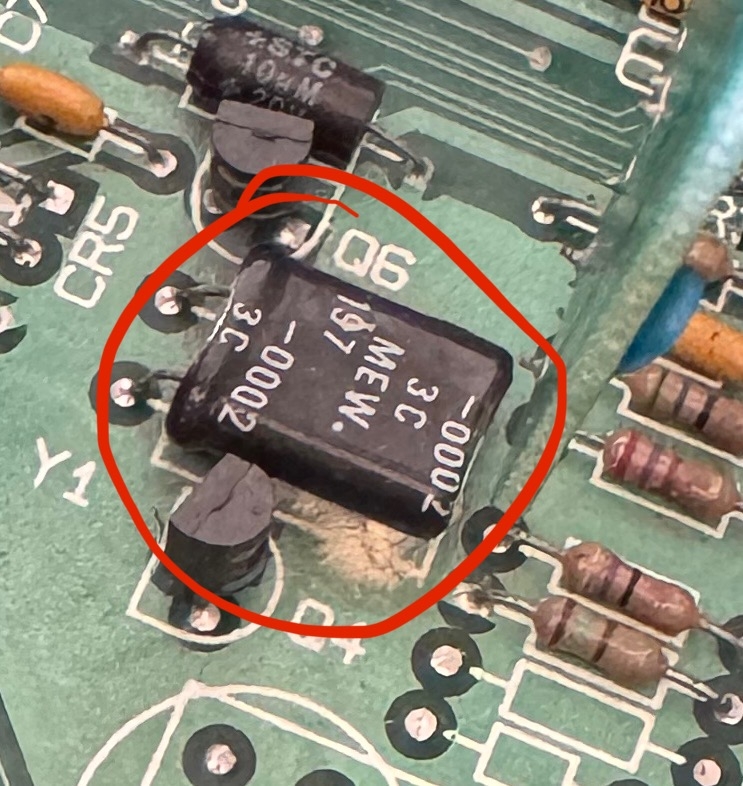
Y1 is a crystal resonator, 14.31818 MHz, that produces the master clock for the Apple.
Crystals do sometimes fail, but it's hard for me to explain why it would have released smoke or a noticeable odor.
Thanks for the ID. I've done some reading and it sounds like those crystals are difficult to replace.
What do you think is the next step? Would you try to find a replacement for the crystal, or start trying to trace around the board trying to find other issues?
It's purely a conjecture, but I've often wondered how easy it might be to replace the Apple II crystal-driven clock with a self-contained oscillator such as ACH-14.31818MHZ-EK sold here at Jameco.
The schematic for the Apple //e includes an option to substitute a self-contained oscillator. Using the Apple //e as a guide, here's how an ACH-14.31818MHZ-EK might be substituted onto the Apple II motherboard...
Replace cyrstal with oscillator.png
It's an untested idea, but I think it would work. Belated thanks to the anonymous Apple engineer who included this option in the schematic for the Apple //e -- the resistor and capacitor are undoubtedly important components to avoid feeding noise back into the Vcc power supply.
Oopsie! Sorry, please disregard my circuit diagram. Somehow I thought you were troubleshooting an Apple II Plus.
But I might have stumbled on a useful alternative for you anyhow...the Apple //e motherboard does have an option for substituting an ACH-14.31818MHZ-EK crystal-controlled clock-oscillator instead of a crystal at Y1. It's easier to source these oscillators than series-resonant crystals, so it might be worth considering.
In fact, your photo even shows where the optional oscillator, resistor, and capacitor would be installed: those are the missing components at the bottom of the picture, labeled in the silkscreen but not actually present. I wouldn't be surprised if someone has already tried doing that, but I don't know of any examples.
That crystal looks fine to me - just looks like it has a bit of dust under it. Gently bend it up, clean under it, and bend it back down. Gently.
It would be extraordinarily unusual for that component to go bad. It's a crystal oscillator - it's not doing much besides resonating.
Chris
They're not difficult to replace, nor are they hard to find.
You can get replacements from digikey for a few bucks.
https://www.digikey.ca/en/products/detail/abracon-llc/AB-14-31818MHZ-B2/675199
You fell into the same trap that has been discussed over and over with regard to crystals on the Apple II. That part is a crystal specified for 18 pF load capacitance in a parallel topology; but the Apple II uses a series topology without load capacitors. The result of using the above part will be a frequency that is too low to produce a color image.
What would be required is a crystal that is specified for series operation at 14.31818 MHz, with no load capacitance. These are still available, with stocks at Digi-Key in the hundreds.
There is still no reason whatsoever to suspect that Y1 has failed, because no information provided by the OP is consistent with a failed crystal. Respondents on this site just love to go on wild tangents.
Could you provide a link?
Thanks!
Sure. CTS MP143: www.digikey.com/en/products/detail/cts-frequency-controls/MP143/67733
I can also recommend the appnote from CTS called Crystal Basics, which explores the reason that oscillation frequency changes depending on load capacitance: look at the graph of reactance vs frequency.
This crystal is 11 MHz and thus it will not work. It needs to be 14.31818 MHz.
Either that, or it's a bad link that redirects to an 11 MHz crystal:
Link.png
I think it's a bad link. Let me try again.
www.digikey.com/en/products/detail/cts-frequency-controls/MP143/67739
I agree 100%. This guy is going to replace the crystal and find the problem either still there, or worse.
Look elsewhere for the problem. That's not spewage of guts under the crystal, it's freakin' dirt. Crystals have no liquid inside them. It's an empty case with a quartz crystal in it.