
Letiss and myself have been working on a USB keyboard adapter over the last few months.
Custom built Raspberry Pi RP2350 board, designed for usb keyboards including those with a wireless dongle. (see attached picture).
Has additional USB-C serial for connection from your laptop/pc etc.
Firmware developed using the Pico SDK and the TinyUSB stack.
GitHub page to follow soon.
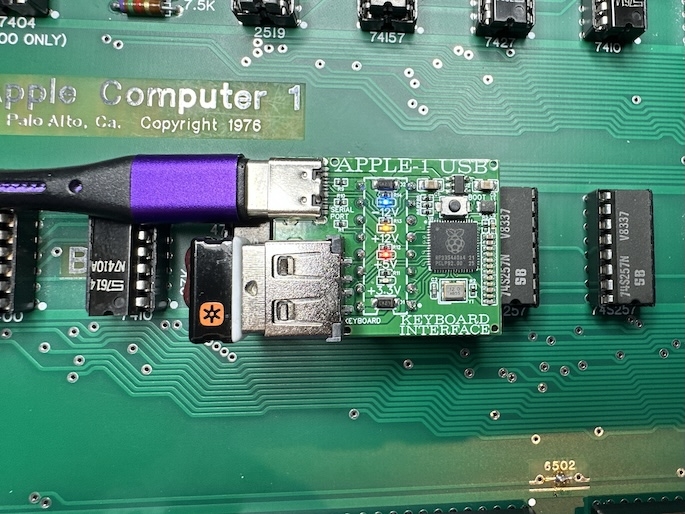
That looks nice and convenient. It probably would not be hard for you to make a version that worked on the Apple ][ and Apple ][+ and clones as well since their keyboard pinout isn't that different.
Nice, I assume the +3.3V LED should light in Orange to stick to the ATX color coding and the +12V is Yellow?
This brings me an idea: to use an ESP32-PICO-Mini-O2 and skipped the USB-C and USB-A connector and used only Bluetooth V4.2 BR with serial and HID-keyboard profile and connect everything to the PIA Socket instead of the keyboard port that would allow something like Apple 1js using a real CPU via Wi-Fi web server.
In post #2, 'softwarejanitor' wrote:
" That looks nice and convenient. "
Uncle Bernie comments:
True that, but I think my own keyboard solution (YAAK and YAAKEN-1) for the Apple-1 looks better and more "period correct", if that is the goal, see post #22 in this thread:
https://www.applefritter.com/content/uncle-bernies-yaak-project-yet-another-apple-keyboard
Still, the solution presented by "Sarnian" in the OP is certainly cheaper to make and own, as USB keyboards are mass produced by the millions. If I was on a budget, I'd go for Sarnian's solution.
But here is yet another nasty thought to ponder (not meant to be offensive to the OP, just for sake of discussion):
A quick internet search for the Raspberry Pi RP2350 reveals it has dual Arm Cortex-M33 or RISC-V cores, 520KB SRAM, and 150MHz speed. So why don't you just emulate the whole Apple-1 with it ? You could run maybe 100...150 Apple-1 emulations at the same time, concurrently. More than the number of original Apple-1 ever built !
To me, it just "feels" wrong to put such powerful MCUs into an Apple-1 system. Just to give you another example, I've just tested an "AI card" for the Apple-1 which, by WiFi, connects to the Internet and allows you to chat with ChatGPT, using the Apple-1 keyboard and video display. So in the end, you could "show" to the typical onlooker that the Apple-1 has "Artificial Intelligence" inside. (Not so ! It's just a trick !). But it feels really spooky ...
Is this where we should go with the Apple-1 ? Plugging in gadgets based on leading edge 21st Century CMOS processes which are 100x faster and have 100x more RAM at 100/th of the price ? Price-Performance ratio being 10000 times better ? Which role does the humble but honorable Apple-1 play in such a setup ?
I still wonder where this is heading. I'm "guilty" myself to do such things like putting a PIC10F202 MCU in the YAAKEN-1 encoder, but I only use 16 bytes of the RAM it has ... and I hide all these modern components out of sight on the bottom of the PCB.
Food for thoughts.
- Uncle Bernie
I did something similar in 2020, albeit less sophisticated, but compatible with Apple-1 / II / II+ and any other computer with a TTL interface.
Special signals such as RESET and CLEAR SCREEN are mapped and can also be also from an external terminal.
I just used a normal Arduino plus a USB shield, and little else.
https://p-l4b.github.io/USBKEY/
https://www.youtube.com/watch?v=ZlYEnyh8RC0
The project is licensed under Common Creative License BY 4.0.
Enjoy,
Claudio - P-LAB